Showing posts with label Terri Schiavo. Show all posts

Friday, November 30, 2007

Announcement-y stuff

Photo badge for finishing NaBloPoMo '07Well, that's over.

Image description: The black-and-white photograph is the upper back of a man with a tribal art tattoo across the shoulders and the following "tattooed" just below: "NaBloPoMo '07 Mission Accomplished" with a little skull image after the "'07". Sara made this and the one from the beginning of the month, which I will leave in the sidebar at right for a while because it's cool. Cooler than me, actually.

So. One mission accomplished and another about to begin. Tomorrow I will begin blogging at Alas, A Blog on a regular basis. I've guest blogged there before for a month-long stint, and now Barry (AKA Ampersand) has asked me to be one of his regular co-bloggers. I'm excited about this for a variety of reasons, and I'll say more about it tomorrow, but two things for now:

First, everything I post over there that is disability-related will also be posted here, and some of the sillier stuff here won't all appear over there. The Gimp Parade won't change except that a couple times a week I'll make a point of writing something that will hopefully be interesting for the larger audience over there to read and maybe even discuss. Content here might possibly improve. Plus, I will be able to keep the focus here on disability and use Alas for occasional writing on non-disability stuff that I am often itching to talk about but don't want to use The Gimp Parade for.

And second, I know that some of my strongly anti-porn radical feminist friends won't want to click over there to follow discussion and might be upset I'm contributing there. (No, Amp isn't in the porn business and you won't find porn at Alas, but about a year ago he did sell his domain name in order to pay some bills. The buyer does link to porn, and you can read more about all that here.) I'm not categorically against porn, and while I could say much more about that, I won't just now. But I hope those uncomfortable with participating at Alas will continue to do so here.

What I will say is that Amp has always been committed to inclusion of disability issues on his blog and in discussion of diversity generally. He and I don't agree on everything about disability. For example, there've been long threads on personhood and Terri Schiavo at Alas that made me want to scream and tear my hair out, partly for Amp's contributions and partly for the tone of many commenters. Step outside the disability blog niche and many (if not most) discussions of disability are much more contentious and not as crip-friendly or nuanced to our experiences. I don't expect this will have changed and while I will personally find it very challenging -- partly because I lose patience and interest when thread comments run into the hundreds -- I don't think it has to be a bad thing.

Amp and I have been discussing disability and other things in various online forums for about eight years now, beginning at the long-defunct Ms. Magazine Boards. That predates this blog by about four years. So, I have trust in Amp's commitment to disability issues and inclusion of the disability perspective in any and all debates at his place, though as I've noted the community of people who comment there are not all of like minds. I hope readers will join us over there to enrich the discussion of disability. It's bound to be interesting.

Wednesday, November 29, 2006

Wednesday gimp blogging

Before Thanksgiving, I had another Parts Replacement Week -- my three-month feeding tube swap and a trach switch. Both went extremely smoothly, and I'm compelled to demystify the process and possession of each a little bit because I know both are considered extreme medical treatments and often used as examples of what people would rather die before enduring.

I wouldn't say it's simple or totally painless to be the owner of a PEG tube or a trach, but both devices have improved my quality of life so significantly that I can honestly say I haven't felt physically healthier in several years. This is because I am getting enough air at all times and have a back-up plan to feeding by mouth, which was harder when I was getting less air, but is also harder for me than the average person because of weakened facial and swallowing muscles.

And it was just a little more than a year ago when my digestive system inexplicably slowed, stopped and rebelled completely. I now have options to starving to death if that happens again. I'm not being extreme when I say that last -- I lacked enough vital potassium and magnesium and I weighed less than 75 pounds when I started that four-month hospital stint last November. I'm over 5'11", by the way. Though many of my muscles are wasted and I naturally weigh much less than the average woman my height, it was critical.

So, the feed tube and trach are good things. And the feeding tube, in particular, is not as drastic or complicated as you might think. As a simple solution to delivering nutrition, it has existed since long before electricity. It's basically a straw, and modern technology allows an older, deteriorating tube to be replaced by a spanking new one in literally five minutes time. I'd definitely rather have my PEG tube replaced than get an ABG (arterial blood gas draw) and probably even a regular blood draw too.

To have the tube exchanged, I do return to the institution where my little stoma was born because they have the elaborate x-ray equipment needed for this and other laparoscopy-type fun. The most complicated part of the procedure is either the out-patient checking-in process or flinging me up onto the x-ray table with all my tubes still attached. Someone splashes Betadine all over my belly, they get the area sterile, the doctor shows up, they lower a drum-like x-ray dealie down low over my stomach, and then they do the deed. They have Novocaine and other painkillers available, but I've never come close to needing anything.

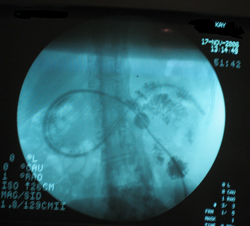
The doctor looks at an x-ray video of my stomach instead of my stomach itself while he threads a guidewire down through the old tube. He pulls that old tube out and there's a little pinch when the balloon that holds the tube in place inside my stomach pops out the stoma. Another little pinch when the new tube and balloon are threaded in. And that's it. Did I mention the technology of this is seriously cool to witness? It is.

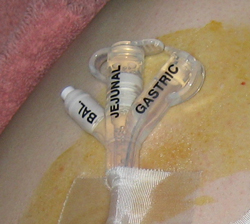
In the x-ray picture above, the small circular spot at the center of the image is the balloon where it sits in my stomach stabilizing the tube. All of the tube you see winding in a figure-eight shape is inside me, providing access to my stomach and also to my jejunum. The next pic is my Betadined belly and the port end of the tube, which has three separate openings -- the capped third one is only used to position the whole shebang.

The writing on the ports of the tube: "Gastric" goes to my stomach proper, "jejunal" leads to the upper portion of my small intestine just below my stomach, and "bal." possibly means "balance." Or "ballast." Or "balloon." Or sometimes, I like to think, "balsamic." If I get liquid nutrition overnight, it's in the jejunal tube, which is helpful when I have hints of the montrous nausea that required the bypassing of my stomach in the first place. And though I haven't had any sort of virus since the installation, I plan to make great use of keeping myself juicy with plenty of healthy fluids by way of these tubes should the need arise.

I keep the tube taped to my stomach most of the time. In the picture it's just basic medical tape but usually there's a fancy sticker gizmo with a tab to hold the tube in one place. Otherwise the tube hangs down from my stomach and flops around like a penis I don't know what to do with.

Have we reached TMI yet? Anyway.

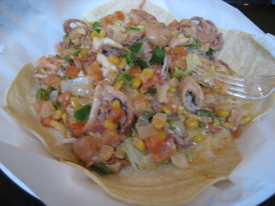
All of the above replacement business is actually just an excuse to go somewhere excellent for lunch. Lately, it's the Midtown Global Market in the renovated Sears building on Lake and Chicago in Minneapolis. I had Jamaican jerk chicken and fresh sweet potato pie three months ago courtesy of West Indies Soul. This time: octopus taco from La Sirena Gorda. It was spicy and delicious, though I had hoped for a larger octopus to make the sacrifice so I wouldn't have to eat little heads and collections of legs whole. I get creeped by eating whole creatures in one bite. But otherwise it was yum and I recommend it for the non-phobic. For dessert, the mysterious Men's Pocky bought at United Noodles, the Japanese grocery.

Aside from the Twisty-like description of lunch, I'm hoping that my explanation of my PEG tube and the simplicity of getting it replaced stands in stark contrast to the idea that because Terri Schiavo owned one, it was one sign her life was over. It's also important to note that court orders for removal and reinsertion of her feeding tube were more complicated than what I've described above. When you're threading a new tube in and not replacing one already there, it's a bit more invasive and definitely involves more pain.

Facts of Schiavo's health aside, all of the feeding tube removal business was to make food and drink inaccessible and was not at all required for denying her food and drink -- the removal of the tube is how modern medicine makes starvation legal and, heh, ethical. It's akin to throwing all your insulin away and then saying "well, there's no way now to save this guy in diabetic shock." It's a legal maneuver that shouldn't be confused with either the actual moral or medical issues of care for any particular individual.

That's all I have to say about Schiavo for now. It always exhausts me to contemplate or discuss the whole mess.

Thursday, March 24, 2005

On Terri Schiavo

As Harriet McBryde Johnson says, "The Terri Schiavo case is hard to write about, hard to think about." I've had an emotional deer-in-the-headlights response about it for quite some time now. Months. And while the legal options for saving Terri Schiavo from starvation may have been exhausted, I'll offer here some writings by others that provide the disability perspective so lacking in the mainstream debate.

Harriet McBryde Johnson on Slate, via Disability Law:

In addition to the rights all people enjoy, Ms. Schiavo has a statutory right under the Americans With Disabilities Act not to be treated differently because of her disability. Obviously, Florida law would not allow a husband to kill a nondisabled wife by starvation and dehydration; killing is not ordinarily considered a private family concern or a matter of choice. It is Ms. Schiavo's disability that makes her killing different in the eyes of the Florida courts. Because the state is overtly drawing lines based on disability, it has the burden under the ADA of justifying those lines.

Steven Drake, research analyst for Not Dead Yet:

Given the current research regarding brain activity and misdiagnosis, it's a virtual certainty that countless people have been helpless to prevent their own deaths through starvation and dehydration. There's an analogy to DNA evidence and the death penalty. Here in Illinois, the staggering numbers of innocent and wrongly convicted people on Death Row resulted in a moratorium on the death penalty. Whether you agreed with the death penalty or not, everyone was forced to find ways to make sure no innocent person ended up on Death Row again. The same amount of concern should apply to medically induced deaths, in which the numbers far exceed the number of convicted people executed each year.
More by Stephen Drake:
People on the right are killing us slowly with cuts to the budget and Medicaid while the people on the left kill us quickly and call it "compassion" -- either way we end up dead -- AND WE OBJECT.

Ragged Edge Editor Mary Johnson's outstanding comments at Common Dreams:
There isn't a single disability rights activist I've heard from who is happy that things ended up at such a sorry pass, and who isn't afraid that this will make liberals hate them even more than they now do. Yet it cannot help being noticed that it generally depends on whose ox is being gored as to what side of the states' rights debate one comes down on. We're all for federal laws when it comes to things like civil rights -- and gay marriage. We're not, though, when it comes to things we've labeled as "right to die" -- which we say are "privacy issues."

We might want to take another look at the cost of such privacy.

Further links to follow here.