Monday, December 18, 2006

Finding the language, making the connection

I've written in the past about being a disabled person before disability studies provided a real forum for discussing social issues about living with a disability. When there were no other disabled girls in my high school and only black studies or women's studies to use as models of systematic and group oppression, and when there were no books available on disability from a social model perspective, I was the kid applying these other theories to disability in my high school and college papers.

Some instructors accepted this, some didn't or tried to lead me back to the "real topic." My immediate family were able to see much of what I did, but I didn't have the language then to really discuss it with them. If I recall correctly, the tabloid paper version of the Ragged Edge -- known as The Disability Rag then -- was my only proof as an isolated teen that my experiences and the socio-political connections I was making about group oppression weren't all in my head.

There's a discussion going on over at Alas, A Blog that reminds me a lot of all this, though the topic is sexual abuse of men or boys and how their experiences do and do not fit into the feminist analysis of sexual abuse and violence. Richard Jeffrey Newman, the author of the post in question at Alas writes what I think is a thoughtful, sensitive and brave piece about his experiences of sexual abuse as a child and where the experiences of men like him can be discussed when the discourse of feminism on the topic is rightfully focused on how men and our patriarchal culture abuse women and girls.

I don't want to talk about sexual abuse here, exactly -- though I will note that there's an article in a recent hard copy of New Mobility that specifically talks about disabled men's problems with abuse, sexual and otherwise. Unfortunately, that particular article isn't available online. (Anyone wanting further info on it can email me, if they wish.)

I'm struck by some of what Newman says about the failure of feminism to "fit" or accommodate his experiences of child sexual abuse as a man. Similar to what I've said about myself above, Newman used feminist theory and writing to articulate his experiences:

Indeed, feminism has been central to the way I understand the world since my late teens-early twenties, when reading Adrienne Rich’s On Lies, Secrets and Silence was the only thing that convinced me I wasn’t crazy (a few years later it was Andrea Dworkin’s Intercourse).
Upon reading Adrienne Rich's feminist book at age 19, Newman recalls:
I don’t know why, but those words pushed a button somewhere in me, and I began to ask—in fact, I actually heard a voice in my head asking—"But what about me? What about what happened to me?"
I remember this sensation of finding the common thread in books about minority oppression and recognizing that they both did and did not speak about my life. There was an excitement, both intellectual and deeply personal, mixed with a bewildered disappointment that what was so obvious a connection to me was nowhere actually in print. The writings by black folks and feminists about their social exclusion and oppression made complete sense and I recognized so much of my own experiences and yet disabled girls were nowhere included as a topic of these common experiences. Disability was invisible as a minority or oppressed category and my individual story wasn't explicitly seen mirrored anywhere. I was grateful for what I had found, but still felt isolated and excluded.

Newman's experienced isolation from the heart of feminist discussions of sexual abuse extended to the use of the pronoun "she":
Nonetheless, the paradox was silencing, so silencing, in fact, that a few years later—and this was after I’d started telling people I’d been abused—in a training session at a different when day camp, when the male session leader told us he was going to use “she” as the generic pronoun referring to kids who might choose to tell us they’d been sexually abused, I found myself unable to confront him about the way that choice rendered me and my experience, not to mention the experiences of the other men and, perhaps more importantly, the boys at the camp who’d had the same experience, invisible. Yes, part of why I didn’t speak up had to do both with the very public nature of the forum I’d be speaking in and the adversarial nature of what I’d be saying, but I also couldn’t speak up because I didn’t have the words, the conceptual vocabulary not only to say “This isn’t fair,” but also to point out that boys’ experience of abuse, my experience of abuse, needed to be understood on its own terms and not as a perhaps anomolous subset of the experience of girls; and one reason I did not have that vocabulary was that it was not to be found in the feminism I’d been reading.
Again, I recognize the strange sensation of having the conversation so unjustly pass him by, like a bus slowing down to pick up passengers along a road, but failing to see you as you hurry to get onboard too. (Or, perhaps even more aptly, the bus lacks accommodation to even let "your kind" get on.) The crowd moves on without you and your search for the many little connections that make up the whole of your humanity suffers another small blow. The haunting part is the uncertainty that can taint the sense of connectivity in personal experience to that particular larger whole. For me as a disabled woman, my sense of womanhood has in the past been damaged by the inability of feminism (and sometimes, individual feminists) to accommodate disability and its contingent experiences into discussions and actions of feminism.

And yet. I find my heart hardened a bit to any complaint from a man about the use of feminine pronouns as exclusionary. This is not to say I don't see the problem Newman explains of his gender being specifically excluded from full participation in feminist discussions of sexual abuse. And I recognize that specific exclusion feels as isolating for Newman as it has for me in other contexts. Rather, my allegiances are divided here, which I also find disturbing.

Women the world over and throughout time have found masculine pronouns exclusionary of their experiences, even -- and especially -- in the most sacred of texts and associations. After all, God is traditionally "he." I have my full share of rage about the continued use of masculine pronouns used generally. Feminism is supposed to be something of an antidote to that. So, how much can feminism be expected to accommodate Newman and other men as victims of sexual abuse in theory or active practice? How to make room for them in what would seem to be the obvious forum for their experiences of abuse by men and the patriarchal structures that deny them another forum to fully express their pain?

And to the extent that male sexual abuse victims will always be partly isolated from the full embrace of the feminist community because their gender is not central to the purpose of feminism, what does this disconnect say about the quest for disabled women to be embraced by the causes and understanding of feminism? Or latino women? Or transgender folks?

On the surface, it doesn't seem like there should be any conflict between feminism and the needs of disabled women as a group, but the rhetoric of feminist reproductive "choice" does not currently include a full understanding or support of how disabled and other minority women experience this choice differently in our society. More broadly, "choice" for feminism and most other liberal groups includes the "right to die," which fails completely to account for the very real dangers (and, in fact, experiences) for many disabled people of being coerced to die.

If feminist discussions of sexual abuse necessarily focus on female experiences, to what extent is the failure to help or support male victims a flaw of feminism? Can it be expected to find a way to better accommodate these men, or would that make feminism something else entirely? Is feminism compatible with the general range of needs of disabled women? If it isn't able to accommodate the meanings of choice when applied to the disability experience, that surely is a failure of feminism to embrace disabled women. So, what does that mean?

Acknowledging that he is writing in feminist space at Alas, Newman says (italic emphasis is his):
I do not believe that feminist discourse is a place where male survivors ought to expect either to speak or to be heard in a way that places our experience at the center of whatever is being discussed.
Is Newman sadly correct? Is not being the center but simply being marginally included enough for abuse victims, disabled women, transgender feminists, and other minorities to whom feminism would seem obligated to serve? What do you think?

Carnival reminders

In case you missed it, the Fifth Disability Carnival is out over at Planet of the Blind. The topic is disability and travel, and the variety of stories about get-around adventures is fantastic.

The next disability carnival will be at The Life and Times of Emma on Thurs., January 11, with the submission deadline presumably Monday, Jan. 8. The theme for Emma's rendition of the carnival is disability and relationships.

If you really want to plan ahead, the Seventh Disability Carnival is expected to be hosted by Museum Freak at Take Me to the Source of Chaos, and if I recall correctly, she's hinted somewhere (can't remember where I read this) that her chosen theme might be disability and technology. MF, correct me if i am wrong. The deadline for this should be Mon., January 22, if my calendar has it right.

The next Carnival of Feminists is coming out this Wednesday, Dec. 20 at The Imponderbilia of Actual Life. There's still time to get submissions in by tomorrow (Tuesday) on the topics of feminism and parenting or women in history.

The most recent Change of Shift -- a nursing carnival -- is up at Protect the Airway. My recent post "Last Year" is over there with other interesting stuff. Some of it's very medical, and from a medical professional point of view, but there are posts from the patient/client point of view as well.

Tasered, trampled and beaten for being disabled

These are three recent stories, one from Pontiac Michigan, one from Gaza, and one from St. Paul, Minnesota:

"Arrested for epilespy" -- Not just arrested, but tasered for having a seizure.

"Trampled because he could not hear" -- Trauma for a 12-year-old deaf boy in Gaza.

"Arrested after running a red light" -- Deaf Minnesotan Doug Bahl went missing when arrested because he was given no access to TTY phone or email to contact family or a lawyer. He alleges he was beaten without cause, as well, and 16 police officers are being investigated.

Saturday, December 16, 2006

Kevorkian paroled

After serving eight years of a 10-to-20-year sentence for second-degree murder, Jack Kevorkian is expected to be free on June 1, 2007. Although he is requesting an expedited release because of allegedly poor health, it appears that Michigan Gov. Jennifer Granholm will not grant that wish. A further reminder of his past:

Kevorkian was convicted in 1999 of second-degree murder in the Sept. 17, 1998, death of Thomas Youk, 52, of Waterford, a victim of the debilitating Lou Gehrig's disease.

The death was different from others in two ways. First, it was videotaped and aired on the CBS show "60 Minutes." Second, Youk was unable to press the button to deliver a fatal dose of drugs, and the tape showed Kevorkian doing it for him, which provided prosecutors with evidence that Kevorkian had stepped past the assisted-suicide line.

Youk was one of more than 130 people Kevorkian assisted in dying. A number of the people Kevorkian "helped" were determined to not be terminally ill even though that is the condition much of the public considers part of their moral reasoning for support of physician-assisted suicide.

The disability rights organization Not Dead Yet released the following statement on Thursday, December 14:
Disability activists were disappointed but not surprised by the announcement on December 13th 2006 that Jack Kevorkian will be paroled on June 1, 2007. Reflecting on years of experience with the euthanasia debate and with Kevorkian himself, the following predictions were made by members of Not Dead Yet, a national disability rights group that organizes opposition to legalized euthanasia, assisted suicide and other types of medical killings:

1. We expect that Kevorkian will show near-miraculous “recovery” from his alleged grave medical problems. He has announced that he plans to speak and write. We expect him to suddenly show enough health and energy to make numerous media appearances and speaking engagements. We could be wrong, but we were suspicious his health problems were greatly exaggerated when his lawyer filed appeals for four years in a row claiming Kevorkian was essentially on the brink of death.

2. Pro-euthanasia advocates will be scrambling to figure out how to maintain control of the debate over euthanasia and assisted suicide. Over the past few years, groups such as the Hemlock Society have reformed and sanitized their images – even changing their name. They’ve worked hard to maintain the fiction that the goals of the euthanasia movement in the U.S. are limited to legalization of assisted suicide for people who are close to death from a terminal illness, despite the fact that Hemlock provided $40,000 for Kevorkian’s legal defense. With Kevorkian once again gaining prominence in the debate, the public will be reminded of his role as a hero to the
pro-euthanasia movement, in spite of the well documented fact that the majority of his body count consisted of people with disabilities who were not terminally ill. It’s also doubtful that Kevorkian will cooperate with the sanitized euphemisms for assisted suicide being promoted by the pro-assisted suicide activists, which will help undermine some of the very expensive public relations work they’ve engaged in over the past few years.

3. Some things are harder to predict than others. Will Kevorkian preside over any more suicides or actively kill anyone? There’s no way to know, since the only rules Kevorkian cares about are his own. The fact that he’s made a promise doesn’t mean anything – he’s made promises to courts before and broken them.

4. Mike Wallace or Barbara Walters can be expected to do a very sympathetic and biased interview with Kevorkian. They’ll downplay his history of helping non-terminally ill disabled people commit suicide and portray him as some kind of martyr. They won’t mention his advocacy of lethal experimentation on death row prisoners or disabled infants at all.

Whatever happens, Not Dead Yet and the disability community will be paying attention and responding to developments. We witnessed the long awaited justice that put him in jail. We won’t forget the struggling disabled people he preyed upon. And we won’t be silent.
From the NDY archives, some information on the now-defunct pro-euthanasia group Hemlock Society.

Other links:

Why assisted suicide is a feminist issue by Barbara Waxman Fiduccia

A 2001 Ragged Edge article by NDY's Stephen Drake about Kervorkian

Recent Detroit Free Press article on the pro-euthanasia movement's response to Kevorkian's parole

Saturday Slumgullion #21 -- Currency Edition

The original news from AP via CBS News: In late November, a federal judge ruled that United States paper currency discriminates against blind people because different denominations of bills are impossible to tell apart without vision or some other assistance.

"It's just frankly unfair that blind people should have to rely on the good faith of people they have never met in knowing whether they've been given the correct change." --Jeffrey A. Lovitky, attorney for the plaintiffs in the lawsuit
This week, the Bush administration filed an appeal, stating (among other things) that blind folks can use credit cards if they want better control of their money.

Our Money Too, an organization supporting the change of paper currency debunks some myths about the process and its effects. Here's one I hadn't thought of myself:
Myth No. 5: The issue of tactilely discernable currency is a "distraction" from important issues impacting blind people.
  • Tactilely discernable paper currency will increase employment opportunities for blind and visually impaired people by affording them greater access to jobs where the handling of cash is an "essential function" of the job.
  • Younger blind and visually impaired Americans will have an easier time finding work in the retail sector-an industry where many young people get their first work-related experience.
  • Improving blind and visually impaired people's access to a wider variety of jobs is especially important considering the fact that between 55% and 60% of visually impaired people of working age and 70% of working-age people who are legally blind remain unemployed, according to the most recent statistics from the American Foundation for the Blind.
Joseph Shapiro's NPR report on some blind people who don't feel money redesign is necessary. It's audio, but there are also images of various foreign currency that does accommodate blind people's needs at the link.

An article in the Christian Science Monitor:
Surprisingly, the ruling was not universally embraced by the more than 10 million blind and visually impaired people in America. While few deny that having differentiated bills would make life easier, some say the lawsuit sends a message that the blind are helpless. Opponents also say it detracts from other problems blind people face, such as unemployment and lack of Internet access.
A statement against currency redesign from the National Federation of the Blind:
The National Federation of the Blind believes that with training and opportunity, blind people can compete in the world with only minor modifications. The American Council of the Blind, which brought the lawsuit against the United States Treasury, promotes the view that the blind are unable to compete unless the world is modified dramatically and specifically for blind people, and that the blind must be made objects of care and pity rather than equal participants in society.
An article from the Press-Enterprise:
"I had a friend who took out a $100 bill thinking it was a $10, and paid for a cab. And the driver kept it," said Shannon Burke, a mostly blind La Quinta resident who teaches along with Davies at the Braille Institute in Rancho Mirage. "If we had some sort of way to differentiate, that wouldn't happen."
At the Howard County Maryland Blog -- "Blind Money and Wasted Resources" questions the Bush administration's assertions in its appeal of the judge's ruling.

At Majikthise, Lindsey Beyerstein writes about vending machines and the government's moral imperative.

Kathy Podgers at From the Port comments on the position of the National Federation of the Blind.

The ruling debated at Overlawyered.

At Speak Up, an unlikely but creative solution: smell-o-cash.

David Gates at Growing Up with a Disability
asks "Why can't we get it?"

At Blind Chance, David Faucheux on changing currency as an "accommodation."

At The Blind Bookworm Blog, Kestrell comments on the currency ruling and on comments to her opinions.

And, at The Volokh Conspiracy, an examination of the ruling and what "meaningful access" means when talking about currency. Comments are interesting -- if infuriating -- too.

Because conservatives are using Judge Robertson's record as a reason this ruling is faulty, here's the Wiki on him.

For the curious: this is an electronic money reader. Notice it's not currently available until March of 2007, and that it costs $270.

Thursday, December 14, 2006

This week at the Gimp Compound

It's been busy around here. On Monday I spent time with four new nurses who will be helping me out. It's been hard for the home health care agency to find them and my parents have spent about four sleepless nights per week for the past two months taking care of me because of the shortage in medical professionals required for state funding of assistance to a vent user. (How's that for a confusing run-on sentence?)

Two of these nurses I met a couple weeks ago and they worked actual shifts where we were adjusting to each other and they were still learning the routine. The other two nurses dropped by for the first time ever, and one of them shadowed another nurse around the house for a couple hours to start learning what the job entails. These new people were in my house and watching me or caring for me in every daily situation from 8 a.m. until about midnight, which was mentally exhausting even though they all seem like competent women who will eventually fit right in.

Tuesday I had a doctor's appointment that consisted partly of getting my primary's script for various things I having the nurses do or not do that need to be medically official. This too, is to satisfy all the state departments and supply and insurance companies that insist on being up in my life. This is the price I pay for not being able to afford severe disability myself.

I did also get weighed, which requires some sort of equipment that accommodates a person who cannot stand. (A chair with a scale attached isn't a complicated idea, but most clinics don't have one so I have to visit the ICU and lay on a hospital bed with a scale built in.) Good, good news there, and I'll write on that separately.

Wednesday I went shopping for the first time since I was sick well over a year ago! Long before I went into the hospital I was ill enough to not go anywhere for fun, so this was a big, fun deal. Yeah, I've been to Target a few times since coming home, always after local doctor's appointments. And I have eaten out and browsed a few places during trips to the Twin Cities for parts replacements events. But I haven't gone anywhere just for the fun of it since 2005. So Wednesday was fantastic!

I went with my sister and a nurse I've employed since I came home last March, and I learned something new about myself during the course of the day. Since I first became visibly disabled around about age twelve, I've always been hyper-aware of disability as a public spectacle and performance. That is, I've always known people are curious and watch, and until now I've never shaken the self-consciousness that is part of the invasiveness of physical difference.

Now, apparently, I no longer give a damn. I'm more visibly interesting than ever, of course, with the puffing vent and tubes coming out of my neck, and I still have to manage interactions caused by public curiosity, but I don't feel vulnerable to other people's gaze in the way I always have. I'll probably write more on this as I think it through.

While at a bookstore (!) looking at a table of fiction, I turned and found a man standing right next to me. Caught staring, he was quick: "I was just admiring your chair," he said.

My chair is hardly the most interesting thing about me, as noted above, but I thanked him and edged my scooter forward a bit. From behind me now, he asked some weird technical question that proved he is probably a medical professional of some sort and was likely admiring my small laptop-sized vent, which even the highly-skilled respiratory therapists at my rehab hospital don't normally get to play with in the vent-users wing where they work. It was surely professional curiosity, and he asked something about whether it provided "oxygenation blah-blah-blah."

He was behind me and I simply shook my head and that was the end of it. But I was thinking, "Dude! I'm in a bookstore for the first time in forever! Look! A new print edition of Pride and Prejudice! Gabriel Garcia Marquez has a new book out! Let me fondle and feel the joy!"

Lunch was T.G.I.Friday's because I wanted a massive menu of cheesy or spicy or breaded and bad-for-me foods. Curiosity at the restaurant too. Did I imagine a couple people pondering for the first time how a woman with a hole in her neck at the next table would affect their appetite? I don't think so, but the difference is I didn't care.

Have I mentioned that I've been speaking now for about two months? The quality of my voice varies but I am able to leave the trach cuff loose enough that I have the constant capability and almost never write notes to communicate anymore. Out shopping, talking, eating -- a tremendously big deal.

Meanwhile, the past two nights have been spent with a hesitant new nurse, so I've felt "on the job" even while sleeping, and I'm pretty tired. But it's been a good, busy week.

I completely missed out on the latest Disability Carnival which is up today over at Planet of the Blind. Stephen and Connie have done a fabulous job and I can't wait to visit all the links.


For those who need the description: The photo above is of my portable vent where it is mounted on the front of my scooter, with the control box of my scooter in the foreground since the picture is taken from my point of view. Hanging from the handlebars is an ugly but functional homemade bracelet that holds the wedge for getting the circuit (vent tubes) disconnected from my trach for suctioning or getting dressed. The wedge looks like a large flat white forked-shaped tooth and because my sister and I are nerds and love the movie Dune, we call it "the tooth! the tooth!."

Monday, December 11, 2006

Bob Sampson RIP

To be honest, I didn't know about Bob Sampson until my sister sent me this link, but he was a remarkable man who died at age 81 this past week. The NPR audio is a bit less than 5 minutes long and worth the time to hear.

For the hearing impaired: I don't know how to get access to a transcript of this or other NPR news except to pay for it. Anyone with better knowledge, please let me know so I can pass it on when I link to audio.

Saturday, December 09, 2006

Saturday Slumgullion #20

Three Guardian articles from the last two weeks -- 1) Identity crisis: Is the disability movement headed in the wrong direction? 2) Disabling the past: A look at the Middle Ages 3) The closed ward: The illogical world inside a psychiatric ward

The New York Times article, "Wanting babies like themselves, some parents choose genetic defects," looks at preimplantation genetic diagnoses that is used to favor embryos with specific disabilities. While the article itself isn't exactly even-handed or disability-positive, the comments following it are simply hostile toward disability -- genetic defectives, in the article.

New York's North Country Public Radio has a "People First" Readers and Writers on the Air series, a more literary continuation of their award-winning "Disability Matters" series from last year that included interviews and documentaries about the lives of disabled folk. Check out the audio archives with Stephen Kuusisto and Reynolds Price. Upcoming programs feature Nancy Mairs, Temple Grandin and Michael Berube.

The Hamilton Spectator article "Poisoned Lives" reports on the radioactive land Navajo's on a Utah reservation call home:

In every corner of the reservation, sandy mill tailings and chunks of ore, squared off nicely by blasting, were left unattended at old mines and mills, free for the taking. They were fashioned into bread ovens, cisterns, foundations, fireplaces, floors and walls.

Navajo families occupied radioactive dwellings for decades, unaware of the risks.

Over the years, federal and tribal officials stumbled across at least 70 such homes, records show. The total number is unknown because authorities made no serious effort to learn the full extent of the problem or to warn all those potentially affected.

The November issue of Perspectives Online, the online journal for the American Historical Association, includes a forum on disability history.

Stuart Hughes, BBC producer and blogger at Beyond Northern Iraq, who lost a leg while covering the war in Iraq is the subject of the BBC News article "Bionic man."

Autism Diva on the recent Newsweek cover story on autism.


Carnival round-up:

Deadline for the next Disability Carnival is Monday, December 11. The carnival will be up at Planet of the Blind on Thursday, December 14.

The latest Carnival of Feminists is up at Diary of a Freak Magnet.

Grand Rounds

Change of Shift

Friday, December 08, 2006

Corbet on nursing homes: Embedded

From Tim Gilmer, the current editor of New Mobility magazine:

Exciting news: a well-known magazine that claims to have the "world's largest circulation" is publishing a story written by New Mobility's late editor, Barry Corbet. Two years after he died peacefully in his home on Lookout Mountain Road, surrounded by family and friends, Barry will have his final say on the disability community's most vital issue. He will carry a familiar motif of ours to the masses -- "our homes, not nursing homes" -- and he will do it as he always did, with well-chosen words and images, deft analysis, and a heart made for understanding sometimes-contradictory human behavior.
Here's the article in the AARP's magazine. It's a must-read.

A tease:

I pulled every string to avoid going to a nursing home after surgery. I wanted to go to a rehabilitation facility. But eventually we all get to a point where our strings aren’t enough. Most people with longtime disabilities are terrified of nursing homes. Many of the young disabled arrive on one-way tickets and spend years or decades attempting to make beginnings amid people occupied with endings. Nursing homes are environments of isolation and disempowerment. They dictate when to get up, when to go to bed, when and what to eat, when to take showers and who will help, and when and if to leave.

The disability-rights movement resists. “Our homes,” we chant, “not nursing homes.” But living with a disability at home takes nerve, know-how, and resources: resources the movement is trying to build but that aren’t yet adequate for most. But too many of us languish in nursing homes until the desire to live in the outside world evaporates. We become lifers, sometimes unable even to get out of bed. It’s not going to happen to me, I tell myself. I’m too well informed. Too proactive.

And:

For 35 years riding a wheelchair has been a distinguishing mark of my identity. In the group photos the wheelchair is what makes me easy to spot. Not here. Here my persona is preempted by all these stupendously old women—there are very few men in the long-term care sections—who create gridlock in the dining room and accidentally lock wheels passing one another in the halls. Practically everyone’s in a wheelchair, but I’m the only one not new to wheels.

Wheelchairs are engines of liberation to me. They enable me to go where I want, when I want. This place reminds me why nondisabled people think they are tragic. In the custodial sections residents are propped up and seat-belted in their chairs, left with nothing to do but the impossible task of getting comfortable on old, unupholstered bones. Their heads hang down and they wait, their chairs no more than movable restraints.

Thursday, December 07, 2006

Last year

My motivation to blog has been limited lately. I think this is related to an on-going preoccupation with what my life was like last year at this time and a conscious effort to appreciate my current freedom (relatively speaking) and soak up the holiday season for all that it is and can be. Precisely one year ago, I was being tranferred from the ICU of a major Twin Cities hospital to the vent-users wing of a rehab hospital. I was a quarter of the way into my 4-month hospital stay.

Besides all the frightening aspects of my medical condition at the time, this move to a rehab institution was a terrifying change because I was leaving behind every medical professional who knew specific details about my care that aided in comfort and minimized pain. I was gambling in my choice among several local rehab institutions I knew very little about. I was counting on all medical records being tranferred with accurate information intact. And, I was leaving a fantastic and motivating physical therapist for unknown replacements whom I worried could never compare to the woman I'd been seeing daily.

I ended up at a great institution full of compassionate, dedicated and very humane people. I was brought there in an ambulance by some guys who could easily start their own comedy act. The broken hospital bed I was put in was quickly replaced with a better one, and my rehab began again. Looking back, things went remarkably well, though there are the inevitable -- and important -- gripes I have with aspects of institutional care. I've blogged about some stuff and I'll blog about more yet.

But what's most on my mind these past weeks are the people, the specific individuals I relied upon at these institutions to literally keep me breathing. When I think back, I'm overwhelmed with gratitude for their kindnesses and awareness of me as an individual lying in that bed.

There was my primary doctor at the local hospital who announced to her colleagues within my hearing that whatever came next was entirely up to me because I was "in charge" -- a declaration that no disabled person afraid of losing her autonomy in a medical emergency can take for granted.

There was the student doctor in ICU who took the time to soothe my concerns about possible interactions between painkillers and my neuromuscular disease.

There was the respiratory therapist who gambled wrongly about my ability to breathe on my own, yet returned to my bedside after the trauma of reintubation to cheer me on for whatever came next.

There was the respiratory therapist I recall through a mid-night narcotic haze because he skillfully eased my breathing like noone else could. When I was still panicky and gasping despite a clearer windpipe, he noted with quiet humor that I could "just breathe" if I only tried.

There's the nurse who gave me courage on one of my darkest days by whispering in my ear to not give up.

There's the nurse who noted I enjoyed All My Children and put a note on my wall encouraging anyone around at noon on weekdays to tune my TV in. Maybe it seems silly, but it was a comforting routine amidst the pain and helped insure one small desire of mine was noted every day.

There's the busy doctor who bought me an audio book of Zora Neale Hurston's Their Eyes Were Watching God so I would have an activity while lying endlessly in bed.

There's the IV nurse who worked on replacing my PICC line (I had five in four weeks) while I lay there and leaked nonstop tears. Before he left he silently wiped my eyes with a compassion that makes me want to weep remembering it.

There's the young nurse who cheerfully called out "Good job, Kay!" everytime she helped me off a successfully-used commode or bedpan.

There's the nurse who checked in on me one evening even though I wasn't her patient in order to ensure that I'd gotten my weekly shampoo.

There's the male nurses' assistants that helped me with the most intimate tasks while maintaining a respect for my modesty and humanity -- not just toileting, but bathing, hairwashing, eating, and lying comfortably.

There's the nurses' assistant who couldn't find my Pizza Goldfish so he surprised me with some other munchies from some vending machine.

There's the nurse who made a point of dropping by with her big floppy puppy over the weekend.

There's the recreational therapist who saw the morning staff were very busy and hung around to feed me breakfast when I still needed the help.

There's the nurses' assistant who shared with me the concerns for her young learning disabled son.

There's the nurse who never once mentioned that her young son was very sick with cancer.

There's the respiratory therapist who automatically knew and understood my desire to learn about all the equipment I use. He'd explained a new humidifier on the vent to my parents while I'd still been in bed and unable to see what he talked about, but he made a point of coming back to it when I was up in my chair.

There's the doctor who kept popping into my room to watch and share the finals of the women's Olympic figure skating competition with me. We rated the costumes and the skating together.

There's the nurse who bought me a little squooshy pillow which I still use every night.

There's the chaplain who gave spiritual comfort by reading poems from one of my books to me. She was at ease with the speechless vent-user and good at sharing a laugh with my parents too.

There are three people I didn't like very much who each greatly humbled me by saying they would miss me greatly when I went home because of my character and personality.

There's the housekeeping guy who unwittingly made me laugh every day with his singleminded thoroughness in dusting the clock and picture frames.

There's the person who called me friend and trusted me with personal news no colleagues knew.

There's the therapy assistant who helped me exercise my limbs while we chuckled through each morning episode of King of the Hill.

There's the respiratory therapist who saw my postcards and we discussed a mutual desire to visit Barcelona, Spain for the incredible architecture.

There's the student nurse for whom I was the very first patient and her gracious way of asking for input to help her serve me and learn worried but touched me.

There's the newly graduated nurse whose error resulting in my trach being pulled completely out has provided me with endless confidence at home because I experienced that emergency under the safe care of the respiratory staff and, thus, learned for myself about worse case scenarios and that I can handle them without panicking.

There are the many people who have immigrated from far away countries and shared stories of their homelands, cultures, ethnic foods, and personal immigration struggles that continue to impress and inspire me.

There's the nurses' assistant who gave me a photo of her youngest daughter -- that child easily wins the award for baby with the chubbiest and most tweakable cheeks ever seen.

There's the social worker who provided excellent family support when the insurance company was trying to institutionalize me in a nursing home.

There are the people who became my friends and I meant to email or meet with more often, but found I missed all of the above professionals so desperately when I went home that I needed to be strong and focus on my life and recognize that I'd hopefully never see them in rehab on a daily basis again.

I haven't mentioned anybody more than once above and I haven't mentioned dozens of other folks who touched me as well. I hope they are all healthy and well and I hope others who must spend the holiday season alone in a hospital bed -- in ICU, rehab, nursing home or any institution -- receive as much compassion and companionship from the professionals who care for them.

Monday, December 04, 2006

Things that crack me up, #15

A google search leading here: "post dramatic stress."

Sunday, December 03, 2006

Looking for a new blog to love?

Neither of these blogs are new -- just new to my blogroll -- but check out Gordon's D-Zone and Brainhell.

International Day of Disabled 2006

December 3 -- today -- is the International Day for Disabled Persons as declared by the United Nations some years ago. At the very least, the declaration obligates countries and organizations around the world to take note once a year of the state of disabled persons in their midst. Here's a sample of that news:

From The Jerusalem Post: Disabled Arabs suffer extreme difficulties. Most notably, the women, of course:

Arab males with disabilities face extreme difficulties, the study reported, but women with disabilities are socially isolated, unable to marry and, in many cases, confined to the home by their own sense of shame, social pressure and the family's reluctance to be seen with them in public.

"Some of the women with disabilities are illiterate, which limits their access to information and increases their dependence on relatives.

Among Beduin women in the Negev who have disabilities, the situation is even bleaker," said the report.

"The situation with disabled women in the Arab sector disturbed me every time it came up," Avital Sandler-Loeff, who authored the report along with Yiffat Shahak, told The Jerusalem Post in an interview. "Women with disabilities are forced to stay at home and are really not involved at all in the community," she said.

A little less balanced report (italics mine):

Arab children more likely to be disabled

The proportion of children in Israel's Arab community who are blind, deaf or have physical or developmental disabilities is double that of the Jewish population, according to the first report on disabilities in the Arab population in Israel. The report is being released today by the Joint Distribution Committee-Israel in honor of International Day for Persons with Disabilities today. The authors attribute the high incidence of disability to the high rate of inbreeding, genetic diseases, childbearing at an advanced age and a high incidence of accidents.
"Inhuman treatment" of the disabled in rural India:

Girdher says, cases of physical abuse of the disabled are rampant in rural area citing cases where a visually challenged girl was raped in Dahod and another woman with visual impairment in the same district was rejected by her physically challenged fiance.

Also, chaining physically challenged people is common in Unjha and Makhtupur, says Girdher adding that in some other areas like Chandroda, polio patients are called “mastans” and revered by family with the belief that the person has absorbed all the ill fate of the family through his disability. “During our study, we have also come across a number of mentally challenged people who have been abandoned by families near Piradata Mazar in Mehsana district.” These are made to take mud baths by the people of the mazaar, he says. “After a thorough situation assessment in districts of Gandhinagar, Anand, Banaskantha, Sabarkantha, Mehsana, Anand, Baroda, Katch and Surendranagar, we realised that while on one hand there is very low level of awareness regarding issues pertaining to disability among both the civil society and the health workers, on the other hand, stigma attached to disability is proving a great hindrance in their rehabilitation. For many, disability is only orthopaedic. They are not aware of other forms,” he says.

Angola's Social Welfare minister pledges to help disabled folks reach fuller partnership in society. This could be a news report from the U.S. or anywhere, but it's not easy to find Angolan news on the disabled. Also, Malta.

In Islamabad, Pakistan, a reporter gamely notes that this year's International Day theme is "E-Accessibility," which is certainly important for any person to be part of this global society, but it also highlights the enormous disparities when life is so direly about survival for so many disabled people around the world. Likewise, in Kuala Lumpur, Malaysia:
E-Accessibility is the theme for IDDP 2006 but here in Malaysia, if the disabled simply have basic accessibility, they will be genuinely delighted and the nation will be one step closer to eventually being a developed country.
A Kuwaiti report on governmental observance of the day reveals typical tensions between focus on charity and a more evolved understanding of what disabled people need from their communities.

In a poignant report on war-caused brutalities and disability in Sierra Leone, a Reuters report shows the connection between violence and disenfranchisement from society:
When Bambay Sawaneh came face to face with the man who had ordered rebel fighters to cut off both his forearms three years earlier, he asked a baying crowd not to lynch his attacker.

"I told the people if they kill him it will not make my hands come back," said Sawaneh, who recognised the man during a physiotherapy session to help him use prosthetic limbs in Sierra Leone's capital, Freetown.

In what became a trade-mark mutilation during the country's 1991-2002 war, the rebels first tried to cut off the then 15-year-old Sawaneh's arms with an axe. But the blade was too blunt to cut through the flesh and bone, so they resorted to using cutlasses -- local parlance for machetes.

"I have forgiven him," Sawaneh, now 22, said of the man he once swore to kill, wiping sweat from his brow with his left stump after a bible class in the steamy coastal city.

Thousands like Sawaneh have learned to come to terms with the horrific acts inflicted on them and their families by the notorious Revolutionary United Front rebels, who financed their campaign of murder, rape and mutilation partly by the trade in gems that inspired Blood Diamond, starring Leonardo DiCaprio.
The Christian magazine Inspire talks about some success in changing attitudes in the Middle East and North Africa.

In Goa, India, an article on how attitudes yet need to change.

The Palestine News Network reports on the toll the ongoing struggle with the state of Israel puts on people living in the Gaza Strip:

And one is hard pressed to find a Palestinian man without a limp, or a bullet or shrapnel lodged somewhere in his body, or an arm that was broken and pushed back into the socket without medical care. And then there are the generation whose bodies were stiffened and twisted in their formative years. Although functional, there are those who after spending their “seventeenth year in a cupboard” in Israeli prison as an Aida Refugee Camp man did, do not move properly and are in constant discomfort.

The Rehabilitation Sector of the Union of NGOs issued its annual statement on Saturday. “The disabled Palestinians affected by such circumstances is the largest of all other sectors. More than 6,000 of the Palestinians injured during this Intifada are suffering from a disability.”

Lest we think the disability divide is mainly in developing countries, Canada's Toronto Star reports on "frightening gaps" in the quest to make disabled people more equal in society:

This week, the Ontario Association of Food Banks reported that people with disabilities, who represent 12.4 per cent of Canada's population, make up more than 20 per cent of those who need their services.

Not surprising perhaps when you consider that the employment rate for people with disabilities is about half that of their non-disabled peers, another frightening gap.
An excellent report from Jakarta, Indonesia, discusses the link between disability and poverty:

The World Bank estimates that 10-12 percent of the world's population, or over 600 million people, have some form of disability. Some 80 percent of them are living in poor countries (WHO, 2006).

People with disabilities are highly over-represented among the poor; about 82 percent of them live below the poverty line. They have varying access to networks and resources and economic power. Their disabilities don't only affect them, but also their families, social networks and their general environment.

Poverty is considered both a cause and a consequence of disability. Poverty is a cause of disability because the poor often lack resources to prevent malnutrition, and access to adequate health services that may prevent disabilities. Poverty is a consequence of disability since people with disabilities often lack access to education, health services and income generating activities and are often deprived of social and economic rights. It is estimated that only 2 percent of people with disabilities enjoy adequate access to basic needs. These factors contribute to high levels of vulnerability and social exclusion, and preserve the vicious circle between disability, vulnerability and poverty.

In Beirut, Lebanon, planned celebrations were cancelled because of the "volatile situation there," but discussion of the social vs. the medical model of disability was nevertheless discussed, as well as the war's impact on disability:

The World Health Organization asserts that 10 percent of Lebanese are disabled. Additionally, 83 percent of all disabled are unemployed - almost five times more than the able-bodied rate. Six hundred were disabled in this past summer's war, and since the cessation of hostilities cluster bombs have disabled a further 150 civilians and continue to mutilate the limbs of more.

"Is it too much to ask to go to school, work and live a dignified life?" Laqqis asks. "I know that there are too many problems to worry about in the government but we shouldn't always be pushed to the end."

Disabled folks participated in a Lebanese marathon Sunday and said it was an example of social equality that they were part of the event.

In Cyprus, disabled people staged a protest to demand their rights:
The Cyprus Paraplegic Organisation yesterday held a demonstration outside the House of Representatives in protest against what they say is the failure of the state to recognise their rights and needs.

“Instead of celebrating International Day of Disabled Persons on December 3, we have decided this year to go ahead with this symbolic demonstration to express our displeasure at the way people with heavy disabilities are treated by the government and the Parliament,” read an announcement issued by the Organisation.

According to the announcement, Parliament had rejected all of the organisation’s suggestions during the recent alteration of the Law for Public Benefits and Services, while the government has repeatedly ignored disabled people’s problems.

As for the United States, I couldn't find any actual formal celebrations or reports about this being a UN-declared day for disabled persons. Just a governmental press release sent out in advance.

Wednesday, November 29, 2006

Wednesday gimp blogging

Before Thanksgiving, I had another Parts Replacement Week -- my three-month feeding tube swap and a trach switch. Both went extremely smoothly, and I'm compelled to demystify the process and possession of each a little bit because I know both are considered extreme medical treatments and often used as examples of what people would rather die before enduring.

I wouldn't say it's simple or totally painless to be the owner of a PEG tube or a trach, but both devices have improved my quality of life so significantly that I can honestly say I haven't felt physically healthier in several years. This is because I am getting enough air at all times and have a back-up plan to feeding by mouth, which was harder when I was getting less air, but is also harder for me than the average person because of weakened facial and swallowing muscles.

And it was just a little more than a year ago when my digestive system inexplicably slowed, stopped and rebelled completely. I now have options to starving to death if that happens again. I'm not being extreme when I say that last -- I lacked enough vital potassium and magnesium and I weighed less than 75 pounds when I started that four-month hospital stint last November. I'm over 5'11", by the way. Though many of my muscles are wasted and I naturally weigh much less than the average woman my height, it was critical.

So, the feed tube and trach are good things. And the feeding tube, in particular, is not as drastic or complicated as you might think. As a simple solution to delivering nutrition, it has existed since long before electricity. It's basically a straw, and modern technology allows an older, deteriorating tube to be replaced by a spanking new one in literally five minutes time. I'd definitely rather have my PEG tube replaced than get an ABG (arterial blood gas draw) and probably even a regular blood draw too.

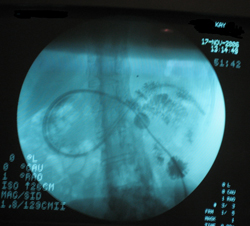
To have the tube exchanged, I do return to the institution where my little stoma was born because they have the elaborate x-ray equipment needed for this and other laparoscopy-type fun. The most complicated part of the procedure is either the out-patient checking-in process or flinging me up onto the x-ray table with all my tubes still attached. Someone splashes Betadine all over my belly, they get the area sterile, the doctor shows up, they lower a drum-like x-ray dealie down low over my stomach, and then they do the deed. They have Novocaine and other painkillers available, but I've never come close to needing anything.

The doctor looks at an x-ray video of my stomach instead of my stomach itself while he threads a guidewire down through the old tube. He pulls that old tube out and there's a little pinch when the balloon that holds the tube in place inside my stomach pops out the stoma. Another little pinch when the new tube and balloon are threaded in. And that's it. Did I mention the technology of this is seriously cool to witness? It is.

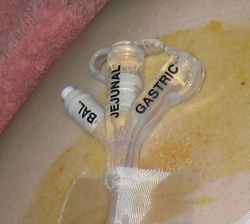
In the x-ray picture above, the small circular spot at the center of the image is the balloon where it sits in my stomach stabilizing the tube. All of the tube you see winding in a figure-eight shape is inside me, providing access to my stomach and also to my jejunum. The next pic is my Betadined belly and the port end of the tube, which has three separate openings -- the capped third one is only used to position the whole shebang.

The writing on the ports of the tube: "Gastric" goes to my stomach proper, "jejunal" leads to the upper portion of my small intestine just below my stomach, and "bal." possibly means "balance." Or "ballast." Or "balloon." Or sometimes, I like to think, "balsamic." If I get liquid nutrition overnight, it's in the jejunal tube, which is helpful when I have hints of the montrous nausea that required the bypassing of my stomach in the first place. And though I haven't had any sort of virus since the installation, I plan to make great use of keeping myself juicy with plenty of healthy fluids by way of these tubes should the need arise.

I keep the tube taped to my stomach most of the time. In the picture it's just basic medical tape but usually there's a fancy sticker gizmo with a tab to hold the tube in one place. Otherwise the tube hangs down from my stomach and flops around like a penis I don't know what to do with.

Have we reached TMI yet? Anyway.

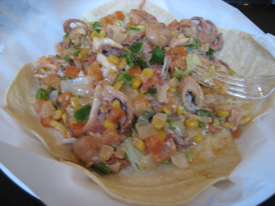
All of the above replacement business is actually just an excuse to go somewhere excellent for lunch. Lately, it's the Midtown Global Market in the renovated Sears building on Lake and Chicago in Minneapolis. I had Jamaican jerk chicken and fresh sweet potato pie three months ago courtesy of West Indies Soul. This time: octopus taco from La Sirena Gorda. It was spicy and delicious, though I had hoped for a larger octopus to make the sacrifice so I wouldn't have to eat little heads and collections of legs whole. I get creeped by eating whole creatures in one bite. But otherwise it was yum and I recommend it for the non-phobic. For dessert, the mysterious Men's Pocky bought at United Noodles, the Japanese grocery.

Aside from the Twisty-like description of lunch, I'm hoping that my explanation of my PEG tube and the simplicity of getting it replaced stands in stark contrast to the idea that because Terri Schiavo owned one, it was one sign her life was over. It's also important to note that court orders for removal and reinsertion of her feeding tube were more complicated than what I've described above. When you're threading a new tube in and not replacing one already there, it's a bit more invasive and definitely involves more pain.

Facts of Schiavo's health aside, all of the feeding tube removal business was to make food and drink inaccessible and was not at all required for denying her food and drink -- the removal of the tube is how modern medicine makes starvation legal and, heh, ethical. It's akin to throwing all your insulin away and then saying "well, there's no way now to save this guy in diabetic shock." It's a legal maneuver that shouldn't be confused with either the actual moral or medical issues of care for any particular individual.

That's all I have to say about Schiavo for now. It always exhausts me to contemplate or discuss the whole mess.

Monday, November 27, 2006

Get yer philanthropy on

Stumped for holiday gift giving ideas? Here are three organizations where you can donate in honor of someone you love:

Women for Women International -- Double your philanthropic power: Any donations given through the end of 2006 will be met by matching funds from someone who is apparently very rich. Or buy something from the org's bazaar. This is my one splurge for charity on my limited funds, and I've sponsored (and communicated with) several Afghan women in the past few years.

Heifer International -- Trapped in the hospital last holiday season, I found a surprising amount of joy in knowing bees, rabbits, and part of a goat had been provided for someone in my name. Not just a charity program, this is an educational system that gives communities ecologically appropriate opportunities, one family at a time.

Whirlwind Wheelchair International -- Ralf Hotchkiss has been working on designing wheelchairs for use by individuals in developing countries since the 1970s and his approach is different than other charities that seek to donate Western-made chairs. WWI teaches local disabled people in 45 countries to build their own wheelchairs, providing a continuing resource for the inevitable repairs all chairs eventually need. There are other organizations that build wheelchairs with plastic patio chairs attached to wheels or collect broken-down used chairs that may not suit the environments they're sent to. WWI considers each disabled individual, allows for custom needs, and creates economic opportunity (often for disabled women) instead of drowning the local market with free chairs. Here's the donation page.

Going Native: Health care

I didn't get to everything I wanted to cover last week, so I'll keep posting until I'm done with my little series on Native Americans and disability.

From Indianz.com:

After 11 hearings, two administrations and countless hours of testimony, Congress has yet to reauthorize the Indian Health Care Improvement Act. The law was passed in September 1976. It expired in 2000 but was extended for one year. Since then, tribal and Indian health leaders have sought to reauthorize the act. But key members of Congress say the Bush administration has delayed the amendment and has objected to many of them. Anslem Roanhorse, the executive director for the Navajo Nation Division of Health, said the amendments are needed to improve services to Indian people. He said a recent attempt to bring the bill to the Senate floor failed.
More information from the Gallup Independent's Navajo Bureau shows that health services for Indians continue to fall behind technologically because of this failure of funding:
Officials have presented data that the Act must be reauthorized in order for health disparities that threaten the future of Indian Country. According to IHS statistics, American Indian and Alaskan Native populations have tuberculosis and alcoholism mortality rates six times higher than the rest of the U.S. population, and mortality rates in diabetes that are three times higher than the U.S. population.
From a July 2006 article by Catherine Komp in The New Standard:

Congress has continued to fund the act through budget appropriations of about $3 billion per year. But indigenous advocates say this sum is inadequate, and that without reauthorization, it also remains uncertain. They point to President Bush’s proposal to eliminate the Urban Indian Health Program in the 2007 budget. Funding for the program, which provides health care for Native Americans living in urban areas, was only recently restored by the Senate.

Health advocates also say that tribes need a new bill to address changing health problems and needs on reservations.

Jim Roberts is a policy analyst with the Northwest Portland Area Indian Health Board who has worked on reauthorization issues for the last six years. "It’s been particularly during this administration that we have met with a number of objections related to different provisions of the bill," he told The NewStandard. "Unfortunately we don’t have the political clout that a lot of other groups have to influence members of Congress, to put pressure on the administration to get these folks to the table to address our concerns."

Why is this Congressional funding so hard to pass and maintain? From Komp again:

"We have a federal government… [that] is essentially turning their head on a population of the US that is increasingly getting sicker," said Joe Finkbonner, executive director of the Northwest Portland Area Indian Health Board and member of the Lummi Nation in Washington.

.... The Indian Health Service also estimates that more than two-thirds of health care that is needed for American Indians and Alaskan Natives is denied.

A 2004 report on Native American health issued by the US Commission on Civil Rights connected these divergent realities to a continued climate of racism in the US.

“While some disparities result from intentional discrimination based on race or ethnicity, more frequently discrimination must be inferred from the continued existence of a chronically underfunded, understaffed and inadequate healthcare delivery system,” wrote the report’s authors. “For Native Americans, the existence of glaring disparities across a wide range of health-status, outcome and service indicators – combined with the manner in which the disparities mirror patterns of historical discrimination – makes a convincing argument that the current situation is in fact discriminatory.”

The report found that inadequate federal funding was a major obstacle to eliminating disparities in Native American health care. It stated that annual increases in funding for the Indian Health Service did not include adjustments for inflation or population growth and were significantly less than those allocated to other arms of the Health and Human Services Dept.

The lack of funding often means Native health providers can only offer so-called "life or limb" services to the most desperate.

Beyond ordinary discrimination, one professor finds suicide rates among American Indians is related to past genocide. From the Spokesman Review:

So far, there has been no such official acknowledgement from the U.S. government, said Maria Yellow Horse Brave Heart, a professor at the University of Denver Graduate School of Social Work.

"So much happened to our people, we didn't have time to recover from one trauma before another occurred," said Brave Heart, a Hunkpapa-Oglala Lakota who developed the theory of "historical trauma" among American Indians.

.... Historical trauma is the intergenerational post traumatic stress that is the result of the genocide perpetrated on American Indians, Brave Heart said. The resulting "cumulative group trauma" was aggravated by the boarding school system imposed on Indian children by both the United States and Canada, robbing them of their traditions, language and families, she said.

The children of the massacre survivors, the boarding school survivors, passed on this trauma to their descendants, Brave Heart said. Hope for Native American children lies, Brave Heart said, in recognizing that this historical trauma exists and reclaiming traditional culture and spirituality through the power of the tribal community and "grass roots healing."

I've been trying to find updated informtion on which what members of Congress have the power in which committees to push this past the lobbies that are proving powerful enough to continue stalling passage of the Indian Health Care Act and other necessary funding, but I haven't located that information yet. Here are some outdated links that will hopefully reflect the midterm elections soon.

Sunday, November 26, 2006

On feet and feminism

Lacking originality today, I point you toward the excellent writing of Sara at Moving Right Along, who uses the meme "Five things feminism has given me" to explore being a woman with a transfemoral amputation in these modern times. (I've got that right, don't I, Sara? Transfemoral?)

Here's a teaser:

Human bodies sometimes experience catastrophic changes. When a woman's body changes irrevocably so that she can no longer don the appropriate costume, for example, when she has to give up a foot, she is expected to fight this with every fiber of her being. She is not expected to fight losing the foot nearly as much as she is expected to fight appearing to have lost a foot. And usually she wants to. No one wants to be discounted.

A woman patient of my prosthetist's former employer was a bilateral trans-tibial amputee who couldn't imagine wearing anything but high heeled shoes, and so her only prosthetics bore feet and ankles made to accommodate heels with "life-like" foam covers. She was considered "marvelous" for not giving in to disfigurement. Without knowing her, I considered her story insane. Yet I understand why she would want to hold onto this. Those heels are her signature, her identity. I can see how that can come to be in our culture, and how devastating it would be for most women to give that up.

Also check out Sara's thoughtful comment to my post on Tammy Duckworth and a discussion on hairy legs over at Toad in the Hole.

Saturday, November 25, 2006

Saturday Slumgullion #19

On Native Americans, indigenous peoples and the blogging of others on Thanksgiving and related things:

Deconstructing the myths of the first Thanksgiving: A bibliography. Via Debbie Reese at American Indians in Children's Literature

American Indians in Children's Literature
-- Yeah, check out the whole blog.

Women of Color: Oaxaca coverage -- Brownfemipower has been covering the uprising and fight for rights of the people in the Oaxaca region of Mexico. Violent political struggles, of course, cause death and impairments and often the people fighting for greater freedoms live in extreme poverty that also causes death and impairments. Browse the blog's sidebar categories for further coverage of nation/state violence, indigenous rights, violence against women of color and disability.

I Blame the Patriarchy: Thanks for nothin' -- Twisty provides a feminist interpretation of Thanksgiving celebration.

My Left Wing: Give thanks for genocide -- Thanksgiving as a National Day of Mourning. And turkey.

My Private Casbah: For those with warm and fuzzy feelings about Thanksgiving -- A collection of Native and non-Native links. Also, 13 reasons why Bint does not celebrate Thanksgiving.

Heart, Mind, Soul and Strength: Pass along the blessings --

Thanksgiving in the U.S.A. has become a season not only of Thanksgiving, but also (unfortunately) a season of collective shame and regret over what our forefathers did to the Native Americans. I'd encourage Christians to take the lead in being clear-headed and constructive on this front, not by sweeping the shame and regret under the rug, but by acting with deliberate generosity towards the Native Nations.

Do we share the blame for the wrongs committed by our ancestors? I'd expect we only share in the blame if we see the continuing injustice and take no action.

Report from Cane Creek: Thanksgiving -- Feast or fast?

Spontaneous Arising: Thanksgiving: Eye of the beholder

Mole's Progressive Democrat: Thanksgiving

The Digest: The Indians -- Fighting terrorism since 1492

Thursday, November 23, 2006

Thanksgiving tradition as seen through Indian eyes

TiyospayesNow writes in "Thanksgiving, Hope and the Hidden Heart of Evil":

When the Pilgrims came to Plymouth Rock, they were poor and hungry -- half of them died within a few months from disease and hunger. When Squanto, a Wampanoag man, found them, they were in a pitiful state. He spoke English, having traveled to Europe, and took pity on them. Their English crops had failed. The native people fed them through the winter and taught them how to grow their food.

These were not merely "friendly Indians." They had already experienced European slave traders raiding their villages for a hundred years or so, and they were wary -- but it was their way to give freely to those who had nothing. Among many of our peoples, showing that you can give without holding back is the way to earn respect. Among the Dakota, my father's people, they say, when asked to give, "Are we not Dakota and alive?" It was believed that by giving there would be enough for all -- the exact opposite of the system we live in now, which is based on selling, not giving.
Go read it all.

Link via Heart

Visit the Disability Carnival #4

The newest installment of the Disability Carnival is up over at Diary of a Goldfish. Great reading for the long holiday weekend there, so check it out.

And get ready for carnival #5 at Stephen & Connie Kuusisto's Planet of the Blind on Thursday, December 14. The deadline, I expect, is the Monday before -- December 11. The theme is "Traveling with a disability: The Good, the Bad, and the Ugly." See you there!