Showing posts with label trach. Show all posts

Sunday, November 11, 2007

Just when you think you're safe

This past August really sucked. September did too. I got a routine feeding tube replacement at the end of July and then had weeks of agony every time I ate because the new tube was not placed right. There was too much of it in my stomach, it turns out, and when I ate the balloon at the end of it slipped down to block food from exiting into my intestines. I felt like I was being poked with a sharp stick from the inside. I was hungry all the time, then had intense pain when I dared to eat.

Of course, the cause of my pain went undetermined for all of August and half of September. It took some persistence to get medical personnel to just get that thing out and try a new one, please. And after a replacement fixed everything so that I was immediately pain-free, there was never an acknowledgment that it was the installation that caused the problem. I didn't even press for that because, well, I know the game. And I also know mistakes happen, I'm often a peculiar case to treat, and excellent doctors can do their best and still not have it work out. It may have been gross incompetence or a routine but regrettable error, and I know I won't get an official medical answer on that. I satisfy myself that I know more about who and where the risks are for the procedure and the institution I go to for it.

But that drama isn't what I want to write about.

On the day I got the successful replacement in mid-September, I first consulted with the doctor in the out-patient recovery unit. See, the painful tube was installed by a doctor I'd never met before. The guy who'd always done it before and who successfully fixed it is the one I've noted before seems to be pretty rude. I'll call him Doctor A. Doc A made some sensible comments in that consultation, saying he'd like to fix one thing at a time -- first the pain, but maybe next replacement I could switch to a Mic-Key tube. I have a G-J PEG tube which I describe here. The Mic-Key goes only to the stomach and is just a button on the outside rather than a tube and ports for both the stomach and jejunum.

In our consultation, Doc A suggested the Mic-Key and I explained that the whole reason I got the feeding tube to begin with is because of stomach troubles that made the jejunal port the key part of my anti-starvation strategy two years ago when I entered the hospital weighing 75 pounds. I can still swallow enough that I eat all my food by mouth now (and have for the last year or so since gaining weight and strength because of that tube), and while eliminating the feeding tube entirely might be a legitimate proposal, eliminating just the part of the tube that has been particularly life-saving for me does not seem logical.

Doc A seemed to accept all that in consultation. Our first priority was to change what he (correctly) thought from examining a week-old x-ray was an improperly placed tube. The week-old x-ray was from a consultation with Doc B, the doctor who had installed that painful tube. B didn't see anything wrong, but A had viewed it and immediately called me to tell me to come in and get it replaced since it looked all wrong to him. So, the Mic-Key tube wasn't the immediate issue anyway.

Then I got in the x-ray room and up on the table under the fluoroscope for the procedure. They took a preliminary look and found my wrongly-placed tube had migrated since the week-old x-ray and looked just fine where it was. (Possibly because I was avoiding food at all costs.) Suddenly Doc A wanted to leave it alone, or put in the Mic-Key. He believed the pain issue solved and had ticked it off his mental list.

I was laying prone on the table, unable to speak while horizontal, as is often the case with my trach. He was pushing for the Mic-Key, explaining how simple and attractive, how less-complicated and more comfortable it would be. The x-ray tech and assisting nurse chimed in.

"Just nod yes and we'll put it in," Doc A said. "Just nod yes. Just nod yes."

Fuck that, eh?

My personal nurse stepped in and said I needed to sit up to speak my mind. So they propped me up enough that I could tell them, "No. No no no no no!"

Get this painful thing out, please. Give me what has worked fine for the past year-and-a-half.

Doc A argued that we could put in the Mic-Key now, and I could always come back and reinstall a G-J PEG if I had trouble down the line. No problem. We'll change it when you say.

"I'm tired of being hungry," I said. If I have stomach trouble I want food that same day, in my jejunal tube.

The x-ray team tried to persuade me: "The longer you have a tube, the more trouble it is. We see this all the time. The Mic-Key is just a cute little button. You'll hardly notice it's there. If it doesn't work you can always come back."

"I've been back. I was here last week. I'm still wearing a damn diaper from the diarrhea-causing contrast dye* from that useless visit. I am hungry. I'm tired of being hungry today."

Doc A did change the tube as I wished. Reluctantly but kindly. And it's worked perfectly ever since.

But when they were saying this: "The Mic-Key is just a cute little button. You'll hardly notice it's there."

Here is what I heard: "If you work harder, you won't need a wheelchair at all. Won't that be nice?"

And: "Show me someone who can't walk, and I'll show you someone who's depressed."

And: "Wouldn't it be great to get off the vent and not have to lug that thing around?"

The answer: Appearance and conforming to the social norm is not in the interest of my health or quality of life. Sitting down to move through the world, when I finally did that in 1983, was a huge relief to me. I could engage with the world rather than being exhausted with the effort of just showing up. Ditto for the vent. Having energy is not depressing in the way that feeling like you're so short of breath you might pass out drags you down.

I don't know what mix of good medical advice and pressure to have me meet an able-bodied norm fueled Doc A and his x-ray staff. I know both were present, as well as A's apparent failure to listen to me in that consultation. In addition to Doc A's expertise in righting another doctor's wrong, here's what I take away from that outpatient visit: I am never safe. They may not be listening to me. They will ambush me when I am least able to speak for myself and try to do their own thing. Their actions will be motivated by medical knowledge and able-bodied assumptions about what I want and need. I am never safe.

--------------------------------------------------------

*Dye injected into the feeding tube shows up on the fluoroscope to assist proper placement. Until it works its way from my very slow-moving digestive system, it's all liquid poop.

Thursday, November 01, 2007

Lately, at the Compound

National Blog Posting Month -- A man's back tattooed with tribal art and I love unpredictability in my friends. People who say or do things it wouldn't immediately occur to me to say or do either intrigue or frighten me. Those who do not frighten me I often want as friends, and I've had some success in getting what I want in that regard.

In the past two years, I've learned that unpredictability is just about the last thing I want in the people who help me daily with personal care, trach health, vent upkeep, etc. I have 24-hour nursing assistance (the "nurse" part being required for state financing of assistance because I use a vent), and other than reliability and competence, predictability is what I crave most in my assistance. When someone is fluttering around me helping with suction or hygiene or other stuff that directly affects my person, the last thing I want is to be watching them and thinking "Now, what the hell are they doing with that?" Predictability requires less mental energy than astonishment or confusion and the less energy I expend with my assistants, the more I have for the rest of my life. And while predictability has been a little elusive at the Gimp Compound lately, it's not my biggest challenge.

It's been my biggest challenge these past two years to adjust to always always having someone present to assist me and keep me breathing. I don't go for strolls around the neighborhood alone, I don't stay home on my own for even ten minutes and I don't wander around the mall by myself. That's new these past two years. I'm a person who has always enjoyed being alone. I like my own company.

The idea behind this constant assistance is that my vent circuit could pop apart (as it does now and then) and no one wants to be responsible for my accidental death from lack of air and suffocation. I can breathe a little bit on my own, and in certain circumstances I can put my circuit back together again, but not so easily that it's a sure thing. So, the trade-off is that I get more supervision than your average toddler.

Having someone always waiting in the wings to assist is not nearly the luxury you might imagine it to be. Intimate discussions are weird with someone close at hand. Lively political debate at dinner always seems peculiar when a silent (and generally professional and discrete) presence sits in the next room. And, in fact, on days when the household has indulged in a big pot of chili it can be downright stifling to family entertainment.

Constant personal assistance is a serious challenge to privacy and personal autonomy, and I've learned a lot about myself and other people while trying to negotiate the space I need. My mp3 player is a key part of my "leave me alone" strategy. So is closing my eyes and pretending to sleep. If you can't escape people -- or even leave the room -- you sometimes must simply shut them out.

I first learned that two years ago while in hospital. If you can't walk away and someone is invading your space: be unapologetically rude. Ignore them. Wave them imperiously away. All young women should be taught this early. I can't believe it took a dire health crisis at age 38 to experience the freedom of blowing someone off when they're in your face and won't go away. Nice Minnesota girls just don't get that memo in their ordinary lives.

Predictability and privacy are linked. To be able to have assistance always around but not intrusive requires that assistance knows what to do without constant negotiation or discussion complicating the day. Home health care provides at least the hope of achieving that in ways inmates of nursing homes can almost never expect. No doubt those who do this care appreciate consistency too, since mistakes happen more easily in unfamiliar situations.

This is where my mental energy has been these past several months when I've been blogging much less. I've switched home health care agencies, said goodbye to four nurses, met and trained three nurses, and some other stuff I'll write about soon. I'm hoping to get back to writing more here this month, and I've joined up for NationalBlogPostingMonth to encourage myself.

Image description: The black-and-white photograph above is the upper back of a man with a tribal art tattoo across the shoulders and the following "tattooed" just below: "NaBloPoMo '07 Blog Free or Die" with a little skull image after the "'07".

Sunday, March 11, 2007

Anniversary -- Escaping institutionalization

This Tuesday, March 6, was the one-year anniversary of my returning home from my four-month hospital stay. What makes the date so important is that my insurance company tried very hard to have me sent to a nursing home after I'd been at the rehab hospital for two months. I was progressing with occupational and physical rehab, I was attempting to wean off the vent, and I was learning how to speak with the trach and ventilator. I was gaining weight -- up to 92 pounds from my low of 75 when I entered the ICU in November 2005.

Had the insurance company gotten it's way, I would have gone to the one nursing home in the entire Twin Cities they considered "in network" and accepting of vent-dependent clients. And I firmly believe that would have led to my death -- quite possibly in this past year.

From the beginning of my medical crisis, my parents and I had talked about how we would try our best to adapt to my changing needs -- the increased need for skilled assistance, the steep learning curve for the vent, trach and feeding tube, the medical bills threatening their financial security as well as mine. The insurance company assigned me a case worker. The hospital social workers helped us begin to navigate the system for state and federal aid. I signed over the title of my van to my folks, an act that terrified me because of how necessary and tenuous being asset-less appeared to my survival. (It's back in my name now, but at the time it was suggested as necessary.)

While I was busy at the rehab center with the minutiae of movement and breath, my parents were working to secure a home health agency and nursing care with state funding approval. Then, one morning, my Mom got a call from that insurance company case worker.

"I've got good news!" she said. "We're moving Kay to a nursing home that's closer to you so you won't have to drive so far to see her! The home is sending someone to assess Kay today!"

This is a person who knew we were working hard to get nursing coverage for me at home. And I don't know how long the insurance company had been planning to drop this bomb, but because I didn't have a telephone in my room (or, really, the ability to speak into it), she was basically telling my Mom the bomb was about to be dropped on me. My parents say they raced to the hospital -- a 90-minute drive -- to keep it from looking like they had decided to ambush and abandon me.

When I was in ICU at first, I was intubated with the breathing tube in my mouth and down my throat. For various reasons, including the Thanksgiving holiday and some scheduling around it, I was intubated for about three weeks and conscious for all but the first couple days before surgery to install the trach at my neck. Intubation by mouth is very painful on the jaw and tender throat. And frightening. During that time -- November 2005 -- I shifted emotionally from wishing I could die and stop the misery, being overwhelmed by the small kindnesses of people and the company of friends and family, and compulsively wondering if this was leading to the end. I was sure it was not, despite my on-and-off despair. I've had pneumonias that felt very deadly and like I might be rattling my way toward death, but this felt like a living transition that I would survive.

And yet, three months later, after the hardest-working, most character-building time of my life, when my parents rushed to my room at the rehab hospital to tell me the insurance company was planning on sending me to a nursing home, my absolute first private thought was, "So this is going to kill me after all."

That's not just drama. I've made a study of how institutionalization leads to the abuse and death of disabled (and elderly) folks -- especially those using ventilators. Like we feminists follow the state of reproductive choice, I have followed the freedoms and lack of them for disabled people in institutions. Abuse and death in institutions has been a theme, along with the basic immorality of warehousing people, in small activist publications like Mouth and Ragged Edge for decades.

As details about this particular facility I was slated to enter became known, it became clear to everyone I talked to at the rehab hospital that being there would likely endanger my health and most definitely halt and reverse specifics of the work I'd done in physical therapy.

As it happened, the one person at that nursing home responsible for assessing incoming inmates was away on a holiday in the tropics and did not visit me that day the insurance company woman said he would. My parents were able to break the news to me, and there would be a weekend reprieve. We learned more about the home in that time -- this home that none of the doctors, nurses, therapists, or RTs that I quizzed at the rehab hospital had any familiarity with. They couldn't recall sending any other patient there, though that was possibly due to a name change, I don't know.

Here are some things I learned about this nursing home I narrowly escaped being sent to, from my parents' on-site tour and my doctors' communication with the facility:

There was a vent wing with about a dozen people there using ventilators to breathe. When my parents visited in mid-afternoon, all these people that they saw through open doors were stuck in their beds.

I was slated for the last room at the end of the hall, as far as you can get from supervision and assistance.

There was no internet access anywhere available to inmates. And no TVs in the rooms. Patients were expected to provide their own if they wanted something to do while immobile in their beds. I suppose this is true of most nursing homes? I don't know.

There was a dining room, but when my Mom asked the home rep if I would be eating in it, she was told it was doubtful. Because of the vent, the woman said, unless I had someone of my own to assist me, I would be staying in my room for meals, and likely for everything else.

Much of the population was warehoused homeless people, probably mentally ill as well as formerly indigent, whom no other place would accept. My parents deduced that a young woman (okay, middle-aged) who cannot walk and is stuck in bed on a ventilator at the end of a long hallway without the power of speech might be vulnerable to physical attacks from mobile, minimally-supervised people with mental issues of their own.

There were RTs (respiratory therapists) on staff but all of them were off-duty every day from 3 p.m. until the next morning. (With my body adjusting to the trach and vent at that time, I was experiencing frequent "mucus plugs" that completely blocked off my airway and required immediate suction relief -- all of these events occurred for me at rehab during evening and night times. More than a dozen times I experienced these plugs, which often hit without notice. Once, I blacked out completely while the RT worked to clear my airway -- and this occurred with a night-duty RT who came immediately to my vent alarm from a desk just a few yards from my bed.*)

The ventilator I would be required to use would not allow for any weaning and would not be portable on my scooter.

I might not be allowed to use my own scooter, which in any case, would be of limited utility without a portable vent.

There was no physical therapy available to help me maintain or increase my strength, which I'd been working on daily to rebuild.
This was the only "in network" option my insurance company was giving me. Without home nursing assistance yet in place, the rehab hospital would not allow me to go home, but the insurance company expected this place would be suitable. My parents were so afraid for my safety and health that they were planning to take turns sleeping in the nursing home room with me, fighting whatever policies might prevent even that. The home care agency we were working with was racing to hire nurses, but expected it would take three weeks to a month.

It did take a month to get the nurses for home care -- and even then, only partial coverage. In the meantime my respiratory health took a little dip, likely because I was crying quite a bit from all this. Concerned, the rehab hospital doctors would not release me to the nursing home, the assessment dude never showed up, and one day, quite suddenly, the insurance company called the social worker and completely relented with the institutionalization plan. I'm sure this is because I had people: my parents to speak for me when I literally could not and wouldn't have had the energy or heart anyway, doctors and RTs who I was awake and conscious enough to build a relationship with so that they perhaps fought a little harder for me in a battle they faced with insurance companies daily. I had resources to keep me from that nursing home I believe would have caused my death. Other people do not.

This one-year anniversary reminds me of how very afraid I was to leave the hospital and the trained professionals behind for my parents' newly-learned suctioning skills and nurses we newbies would have to train. I'm home and happy, though unemployed and baffled as to how anyone who has to manage full-time assistance does anything else useful with their time. I'm hoping to figure that out in the coming year. This is a bittersweet anniversary to celebrate when I understand how very very lucky I am, and how the story is much different for other people who do end up in nursing homes and other institutions.

__________________________________________________

* Because of medication, adjustment to the vent, and a lowered cuff that prevents sudden total blockage, plugs are not an emergency I have had for about ten months now. This is the result of a lot of hard work and vigilance on my part. Conscious, alert, and in charge of my own health care here at home, I can weigh all the factors and adjust medication that prevents plugs, refuse meds if I don't need or want them, ask for suction, request more or less water in my cuff -- all without being institutionally "noncompliant" or having something decided without my input or consent. Until I was able to verbally express these wishes, my written communication was respected and "heard" by people who my family and I were able to assure cared about my preferences.

Cross-posted at Echidne of the Snakes. Check for more comments and discussion over there.

Thursday, March 01, 2007

Like a lion -- A rant

Last weekend we got 15 inches of snow here at the Gimp Compound. Since I'd managed a successful Parts Replacement Event with my feeding tube just a few days before and had no place I needed to be, a snow day or two was cool with me.

But this week. This week has been more of an on-going adventure. Tuesday, a family member wandered over to the local Menard's and tripped over some poorly-placed lumber, cracking bones in her wrist and knee, spraining an ankle and breaking a toe. Half my nurses -- those who are licensed LPNs attending the local college for their RNs -- are bogged down in what appears to be a departmental failure to provide the needed education. A suddenly-changed school policy requiring they do their online computer homework at the college instead of at their convenience means that one of my nurses has had to cancel a night shift, which means my gimpy relative with the weak bones has two nights per week to try and help me in ways she can't possibly, at the moment.

And the snow plows have given up for now. Visibility is too low. Tonight's nurse made it here over slippery roads. Hopefully tomorrow will see the roads clear. In the meantime, my back-up batteries are ready in case the power goes out. I can last for 16 hours on them, if I need to.

And yet this is not the most distressing news of the week. My medical supply company called today to say that Medicare will not allow them to give me more than 90 trach suction kits per month -- that's three per day, when I always need an average of maybe five, and some days easily nine or ten. Trach suction kits consist of sterile gloves, a sterile container for the sterile water used to lubricate, and a sterile plastic catheter that slips down my windpipe to suction up the lung gunk that bypassing the upper respiratory system triggers my body to make. The catheter is connected to a little vacuum machine that provides the suction. This is the key service my paid help must provide in a sterile format in order to keep me, or anyone with a trach, healthy. Without suction I will literally drown.

And I cannot pay out of pocket for what Medicare will not cover because that would mean I do not need the state to help pay for my nursing help. Have I mentioned that while most all of my nurses have needed to be trained to do this suction (because it is not a basic skill all nurses learn to qualify as nurses), the state nevertheless requires that nurses be provided if it pays for my help? I'm happy with the women who work here -- though we need twice as many of them -- but their required qualifications do not mean they are trained to do what I require. And of course, they cost more to employ than a non-nurse who would have to be trained to suction in the same way. And with the shortage of available nurses, I do not have the staff that I need.

The Medicare rules about three suction kits per day are not new and do not affect only me, of course. As I understand it, I can get some sort of medical waiver through my doctor certifying I need to not drown and must have suction available when I need it instead of just three times per day, rain or shine. Apparently that waiver will be required attached to every sale of every kit beyond the allowed amount for as long as I need them, which will be until I stop breathing, basically. Somewhere there are people paid to look at these waivers all day, in perpetuity. From a listing of these rules:

If Medicare determines there is medical necessity, the standard allowable for the following items are listed below. Medicare may sometimes approve larger quantities, but that decision is made on a month-to-month basis by the individuals reviewing the claims. They may approve larger quantities one month, but disapprove them a different month. For the most consistent reimbursement by Medicare, you may want to consider placing one order per month, staying within the limits listed below.
My orders to the medical supply company are already monthly. I have no idea how complicated getting this waiver and getting permission for the medical supply company to give me extra kits will be (is there a special form? can I get kits on credit in the meantime? will I need to get a doc to sign the form every single month for the remainder of my life?), so it's a lucky thing I have a few extra kits just now. As I said, I cannot buy out-of-pocket what I need to breathe because my state-paid nursing care would be cancelled altogether.

As far as I can tell, this is how it works. You qualify for Medicare, and muddle along until one of the obscure rules bites you in the ass and threatens your life. Then you see what you can do to survive. Or the system fails you.

It's not a matter of wise or difficult funding choices. No one is out there allowing sterile catheters to be shoved down their windpipes willy-nilly, recklessly suctioning when they don't really need cleaner airways. The kits I currently use cost about $5 each, which, let me assure you, is peanuts compared to many other innocuous pieces of plastic that I also require. If I didn't have enough kits, or had to use non-sterile equipment that caused an infection and forced me to go to the hospital, my Medicare would kick in to pay for much more than a few extra measly kits per day.

And I finally saw my pulmonologist yesterday, for the dizziness of seven weeks ago, which has abated almost completely now. I think it was caused by weaning off Dr. Perky's Effexor. I confirmed that I more or less know what I'm doing with the ventilator settings, and a blood gas proved all is well. (A competent RT had absolutely no trouble making me bleed.)

I like this doctor, and we discussed a drug I use in a nebulizer that the pharmacy has insurance reimbursement problems with. The pharmacy will only give me the big bottles of the liquid medication (30 ml as opposed to 4ml bottles), which then expire and must be thrown away before I have used half of each bottle. Half my prescription goes into the garbage because of the size of the vials I'm sold. Then my monthly prescription runs short and the insurance company freaks out because I need more too soon. I will try to wean off that drug, if I can. The doc says that's best anyway, and may be possible. Or switch to mail order drug supply and see if that doesn't work. (Incidentally, this drug -- Mucomyst -- keeps the lung gunk from getting too thick, allowing me to need less suctioning.)

None of this is about insurance or Medicare providing what I medically need or even necessarily saving them money. It's about policies that don't fit individual needs and apparently are not to be budged.

Do not even get me started on the single-use sterile saline bullets sometimes used to dilute thick lung secretions so that suctioning is easier and causes less trauma. Medicare simply states they are not necessary and will not be covered at all. They were used frequently at the first-rate rehab center that taught me what I need to know to keep myself healthy. I have some in a box here, and use one or less per day. Now I learn they are completely unnecessary and the comfort I have noticed from their use is a figment of my imagination.

Gah.

Monday, February 05, 2007

Random Parts Replacement Fun

Ventilator traded in for one which does not randomly turn itself off:

Check.

New ventilator's obscure nonprescription default settings changed (by an adventurous nurse!) to match the other one I have here at the house so that I can use it without getting an immediate headache:

Check.

Trach changed by my mother while the local doctor watches so that she can stop having nightmares about what might have gone wrong during the emergency switch last month:

Check.

Appointment to get my scooter fixed so that it will stop drifting backwards randomly and risking sudden trach/vent tube crisis:

Check.

Plans with a local welder to fix the rack that holds my vent to my scooter so that it will stop threatening to fall off randomly:

Check.

Appointment for routine feeding tube Parts Replacement Event:

Call tomorrow.

Whew.

Friday, January 05, 2007

Friday at the Gimp Compound or Dizzying up the Girl

So, about ten days ago, my trach's cuff burst. In my throat, in the middle of the night. And just for fun, this happened when I was just coming down with a virus of some sort and happened to be sitting on the toilet. I was with a new nurse -- new to me and new to the profession, so she'd never seen a trach switch before. And my Mom had never done one, but we woke her up for the opportunity. Dad was there too -- it was an exciting event for us all.

But it went very well. When I'd last had a scheduled Parts Replacement Event, I'd asked the doctor to show both my mother and the nurse present how to do it. We were mostly prepared. We only lacked sterile lubrication to make it easy to slide the new one in. But in the excitement, we didn't pay the usual attention to the exact amount of water to fill my cuff comfortably with.* And we didn't adjust the strap around my neck just right -- because I have a scrawny neck, the trach can be shoved in too far so that it curves against the back wall of my windpipe and the opening is curved up against the front of my windpipe, which both hurts and impedes delivery of air.

What with the virus and this trach switch requiring fine-tuning for optimum breathing and comfort, I've been pretty dizzy the last ten days. Oh, and I've just finished weaning off the Effexor Dr. Perky placed me on in rehab, so that might be contributing to my dizziness too.

I've got an appointment for a blood gas** next week and I've spent part of today with the cuff filled beyond speaking-capability in order to better approximate the exact settings I used in the hospital, which is when I was last monitored by RTs and a pulmonologist. I've been the vent expert in my life since I came home with the machine last March.*** Ironically, state-paid home health care for a vent user requires hired nurses, but nurses are not trained in the specialty of vent management unless they get special training to be ICU nurses or the like. Nurses also are not typically allowed to do trach change procedures, though obviously it is necessary that they be prepared to step up in a setting like mine if I need one in an emergency.

Respiratory therapists get training on ventilators, what the settings all mean, how they effect a patient, and they learn to do trach changes and take blood gases (and do the lab work) as part of their routine in a rehab hospital like I was at. I very much enjoy the individual women who are employed as nurses for me, but geez. The rules don't quite fit the purpose and I need an expert just now.

Oh, and there's a new nurse coming to work here tonight. I don't know if she's ever done suction, worked with a vent, or what. So finding that out is my job tonight. I'm dizzy and tired and fed up with these regulations that don't really give me the full expertise they claim they do.

______________________________________________

* The cuff is the inflatable part of a trach that puffs up in the windpipe to ensure that the air going in the tube gets to my lungs and doesn't go upward and out my mouth and nose instead. The trach I currently use, a Bivona TTS, inflates the cuff with sterile water instead of air, which other kinds of trachs use. So when it burst, I immediately got about 7 or 8 ccs of water in my lungs in addition to not getting the vent air where I needed it. And we added about 5 ccs more before being certain the cuff was blown.

The photo above is the Bivona TightToShaft trach kit, which includes the trach itself (top left), the obdurator (shaped in a gentle curve like the trach, it's hard plastic that fits inside the trach tube to help with insertion), and the wedge or "tooth" (top right, used to unhook the installed trach from the vent tubes for suction or getting on clothing). The red cap to seal off neck breathing while leaving the trach installed and cheapo trach tie I do not use but both are also in the picture above. You can't really see the cuff, but it looks just like a little condom on the end of the naked trach. The tiny photo inset shows the cuff inflated.

** A blood gas (or arterial blood gas, ABG) is a blood draw taken from an artery in order to measure oxygen, carbon dioxide and other stuff. In this case, it helps determine if my ventilator settings are giving me too little or too much air.

*** When I say that I am the vent expert in my life, I mean that I know more than any person who comes in contact with me -- including the dude from the medical supply company who is supposed to come monthly and do a maintenance check on my machines. I know what the codes are for the various alarms when they go off, I know what the settings of frequency, sensitivity, tidal volume, expired tidal volume, PIP, PEEP, MAP, etc. all mean generally and in terms of what I suposedly need. I know how to cancel the alarm and change settings depending on if I am getting sufficient air, which varies according to how full the trach cuff is. I know that a high pressure alarm usually means there is condensation in the sensor tubes and I know the ways to fix that. I'm happy and proud I have learned all this in the past year, and it was my responsibility to do so, but given that I am required to have nurses in my presence constantly in order to receive state aid for home care, I am not thrilled that I know more than every single professional around me and that their nursing training does not mean they bring the actual vent machine expertise to the job.

Wednesday, November 29, 2006

Wednesday gimp blogging

Before Thanksgiving, I had another Parts Replacement Week -- my three-month feeding tube swap and a trach switch. Both went extremely smoothly, and I'm compelled to demystify the process and possession of each a little bit because I know both are considered extreme medical treatments and often used as examples of what people would rather die before enduring.

I wouldn't say it's simple or totally painless to be the owner of a PEG tube or a trach, but both devices have improved my quality of life so significantly that I can honestly say I haven't felt physically healthier in several years. This is because I am getting enough air at all times and have a back-up plan to feeding by mouth, which was harder when I was getting less air, but is also harder for me than the average person because of weakened facial and swallowing muscles.

And it was just a little more than a year ago when my digestive system inexplicably slowed, stopped and rebelled completely. I now have options to starving to death if that happens again. I'm not being extreme when I say that last -- I lacked enough vital potassium and magnesium and I weighed less than 75 pounds when I started that four-month hospital stint last November. I'm over 5'11", by the way. Though many of my muscles are wasted and I naturally weigh much less than the average woman my height, it was critical.

So, the feed tube and trach are good things. And the feeding tube, in particular, is not as drastic or complicated as you might think. As a simple solution to delivering nutrition, it has existed since long before electricity. It's basically a straw, and modern technology allows an older, deteriorating tube to be replaced by a spanking new one in literally five minutes time. I'd definitely rather have my PEG tube replaced than get an ABG (arterial blood gas draw) and probably even a regular blood draw too.

To have the tube exchanged, I do return to the institution where my little stoma was born because they have the elaborate x-ray equipment needed for this and other laparoscopy-type fun. The most complicated part of the procedure is either the out-patient checking-in process or flinging me up onto the x-ray table with all my tubes still attached. Someone splashes Betadine all over my belly, they get the area sterile, the doctor shows up, they lower a drum-like x-ray dealie down low over my stomach, and then they do the deed. They have Novocaine and other painkillers available, but I've never come close to needing anything.

The doctor looks at an x-ray video of my stomach instead of my stomach itself while he threads a guidewire down through the old tube. He pulls that old tube out and there's a little pinch when the balloon that holds the tube in place inside my stomach pops out the stoma. Another little pinch when the new tube and balloon are threaded in. And that's it. Did I mention the technology of this is seriously cool to witness? It is.

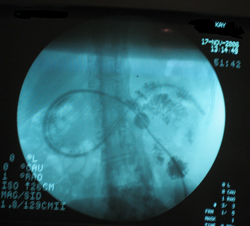
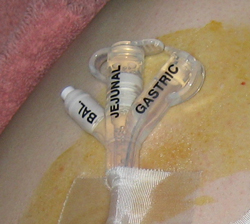
In the x-ray picture above, the small circular spot at the center of the image is the balloon where it sits in my stomach stabilizing the tube. All of the tube you see winding in a figure-eight shape is inside me, providing access to my stomach and also to my jejunum. The next pic is my Betadined belly and the port end of the tube, which has three separate openings -- the capped third one is only used to position the whole shebang.

The writing on the ports of the tube: "Gastric" goes to my stomach proper, "jejunal" leads to the upper portion of my small intestine just below my stomach, and "bal." possibly means "balance." Or "ballast." Or "balloon." Or sometimes, I like to think, "balsamic." If I get liquid nutrition overnight, it's in the jejunal tube, which is helpful when I have hints of the montrous nausea that required the bypassing of my stomach in the first place. And though I haven't had any sort of virus since the installation, I plan to make great use of keeping myself juicy with plenty of healthy fluids by way of these tubes should the need arise.

I keep the tube taped to my stomach most of the time. In the picture it's just basic medical tape but usually there's a fancy sticker gizmo with a tab to hold the tube in one place. Otherwise the tube hangs down from my stomach and flops around like a penis I don't know what to do with.

Have we reached TMI yet? Anyway.

All of the above replacement business is actually just an excuse to go somewhere excellent for lunch. Lately, it's the Midtown Global Market in the renovated Sears building on Lake and Chicago in Minneapolis. I had Jamaican jerk chicken and fresh sweet potato pie three months ago courtesy of West Indies Soul. This time: octopus taco from La Sirena Gorda. It was spicy and delicious, though I had hoped for a larger octopus to make the sacrifice so I wouldn't have to eat little heads and collections of legs whole. I get creeped by eating whole creatures in one bite. But otherwise it was yum and I recommend it for the non-phobic. For dessert, the mysterious Men's Pocky bought at United Noodles, the Japanese grocery.

Aside from the Twisty-like description of lunch, I'm hoping that my explanation of my PEG tube and the simplicity of getting it replaced stands in stark contrast to the idea that because Terri Schiavo owned one, it was one sign her life was over. It's also important to note that court orders for removal and reinsertion of her feeding tube were more complicated than what I've described above. When you're threading a new tube in and not replacing one already there, it's a bit more invasive and definitely involves more pain.

Facts of Schiavo's health aside, all of the feeding tube removal business was to make food and drink inaccessible and was not at all required for denying her food and drink -- the removal of the tube is how modern medicine makes starvation legal and, heh, ethical. It's akin to throwing all your insulin away and then saying "well, there's no way now to save this guy in diabetic shock." It's a legal maneuver that shouldn't be confused with either the actual moral or medical issues of care for any particular individual.

That's all I have to say about Schiavo for now. It always exhausts me to contemplate or discuss the whole mess.

Monday, November 06, 2006

My déjà vu

Wednesday, November 8, 1989 was a beautiful day in Tempe, AZ, with the sky a cloudless blue. I was up early, waiting at the front desk of Palo Verde East dorm at ASU for my friend Marian's step-father who was coming for all the boxes of Marian's things. He never showed. Around 8 a.m. Deb came instead to tell me personally that Marian was dead.

Deb looked good. Relieved. Over three years before, as the roommate before me, she'd promised to be at Marian's bedside if/when she died, and she'd been tirelessly attendant in the ICU for three weeks. She told me how it ended -- the gradual failure of organs and the mid-night final, peaceful slowing of her heart until it simply stopped. Deb smiled and said it was the most beautiful thing she'd ever seen.

Marian had been comatose for about ten days with a temperature of over 104 degrees. We'd known it was over. I'd spent that Halloween watching the macabre college partying all around me as I tried to absorb the fact that she would not be recovering. Before that, we'd known she would miss the rest of the school semester and a friend and I used nervous energy to pack up her belongings in the dorm.

I'd last seen Marian before the coma came. I'd ridden two buses with a friend, and we arrived as they called a Code Blue for her. A nurse found us shortly and asked for someone strong enough to calm and comfort her after the pain and fear of resuscitation. Nevermind strong, it was now or never, literally. We'd arrived during a rare break for her family and they weren't anywhere to be seen.

Marian's lips were blue around the intubation tube and her neck was not at the angle that juvenile rhumatoid arthritis had stiffened it to in her childhood. They'd probably had to break something in her neck to tilt her head back and insert the breathing tube. She was swollen from massive doses of predisone, and there was fear in her beautiful bloodshot blue eyes.

I held her hand, having no idea then what an incredible physical comfort that can be when frightened and unable to speak. And she was frantic to speak. There was an alphabet board -- another thing I was to learn about eventually too -- for communicating and she trembled as she pointed out the letters successively.

C. O. I. N.

She gestured to me and I ran through obvious possibilities, none of which satisfied her. Yes, C. O. I. N. but not "coin." She meant something more. She was insistent, emphatic. This was important to her to say. We couldn't communicate and I didn't know if her eloquent, brilliant mind was working clearly. She kept spelling out COIN and waving her arms at me while I tried to be calm and reassuring. I quizzed her. She didn't need anything. She wasn't trying to talk about money. This was something she wanted to tell me.

This continued until Deb and her family arrived, rushing in with alarm after hearing she'd stopped breathing. Nurses asked for someone in the crowd to clear the room and I reluctantly volunteered, not knowing then how slow her leaving us would be.

Now, I can imagine exactly how frustrated she must have been with me. I didn't let her "speak." I failed to solve this mystery. The very last thing she tried to say to me I didn't understand. And I left the room with it unresolved. She wasn't conscious after that day.

That was 17 years ago. One year ago I was hospitalized with desperate digestive problems and pneumonia from endless vomiting. Exhaustion on top of disease-weakened abdominal muscles made it difficult to breathe. Locally, they intubated me and sent a camera down my esophagus to see what was up, then I was flown by helicopter to St. Paul and expected surgery.

Heavily drugged, I only remember the helicopter lifting off, then no clarity of memory for about two days. But during that lack of clarity, I had a vivid, unforgettable experience. Through the blur of sedation, I was aware of medical people working over me. As they did various procedures on me, including installing a feeding tube to my stomach and jejunum, I experienced total, extended déjà vu. I anticipated and then experienced -- over and over again -- what was happening.

I don't have any clear memory of what specifically occurred, but I remember being shocked and even alarmed by this mystical déjà vu as it repeated itself relentlessly. It seemed to go on and on, and though I have no doubt the sedatives caused the experience it was still a mystical, even spiritual, event.

I woke up from the drug haze in a private ICU room that, ironically, had a thermostat problem causing a periodic hissing noise that truly sounded like Marian's trusty but dilapidated power wheelchair from long ago. The cycle of hissing-silence-hissing of the thermostat by the door sounded as though Marian was doggedly circling the ICU hallway outside my room.

I spent the next month lying in that bed spelling or writing out messages as Marian had tried to do. And it was then that it occurred to me with a certainty: Coincidence.
Déjà vu.

Monday, October 02, 2006

The saddest entourage ever

I've never seen the HBO series Entourage, but I know entourages are supposed to be cool. Hip. Impressive. They're supposed to help acquire stuff, and beautify the star, and enlarge the star's importance with their very presence.

Here at The Gimp Compound it's Parts Replacement Week. Today I went to the local clinic to have my trach swapped for a newer, less ooky one and Wednesday there will be drilling of teeth. Too bad the attendants can't be sent ahead to have their teeth drilled instead of mine. I would so go for that.

Yes, I have attendants. They're my folks and the state-paid nurses I've referred to before, and though a nurse is supposed to be here 24/7 as long as the state is paying for any care of a person with a vent, they're covering about 60% of the hours this month and my weary parents are handling the rest. Anyway, there's always someone lurking about me.

In the past I've brought my parents to many doctor's appointments -- particularly the specialists because 1) we all know the drill, 2) I feel more powerful with them there, and 3) we can remember things better if we all try together. In the hospital, especially when very helpless, it was really important they were around. I focused on not letting anyone accidentally injure or kill me, and my parents worried about other details. I don't know how anyone manages all that alone.

So. I have this nurse who goes where I go, and parents who have a knack for teamwork in the doctor-patient arena with me. All four of us went to the clinic together today for the trach change. And while there is good people-watching of all kinds there, I'm sure we are something to see. If you wandered into the nearest church lutefisk dinner and picked out two reasonably limber senior citizens and a women aged 35 or older, you'd have an idea of the utter coolness of my entourage. They carry gauze and saline. They wear comfortable shoes.

My entourage. My posse. My gang. My, uh, parents and my nurse.

Thursday, April 27, 2006

My very own Nurse Ratched

It's funny what sticks in your mind about a person and becomes either a lovable quirk or a trait you will never be able to stand wherever you find it again. I've recently developed a strong aversion to the phrase "just a titch," which was always a bit dubious but now makes me want very badly to slap the person who says it.

There was this nurse -- I suppose there was bound to be one, since 12-hour shifts for four months equals 240 nursing opportunities to meet someone not even a mother could love. Here's what she liked to do: Knowing I couldn't speak because of the ventilator* and couldn't escape her for the duration of her shift, she liked to put her face down close in front of mine and loudly ask personal questions that were none of her business.

"ARE YOU SAD?!"

It takes a special talent to violate someone's personal and emotional space with such a simple quetion. Yet she had the knack.

When I didn't answer (I was busy contemplating what the correct "fuck-off" response is to someone whom I might have to ask to wipe my ass within the hour,) she began to lecture me about "bucking up" and "this too shall pass" and all that. "Sad" really wasn't an issue so much by this point as, perhaps, "livid."

She stirred up my mild-mannered Minnesotan parents too. They came to visit that Sunday hoping we'd immerse ourselves in the benign weekend hospital limbo you get if nothing too urgently worrisome develops. It's a sort of boredom you feel lucky about.

Instead, this woman began asking questions about my future, and then stating that what we (the doctors, my parents and I) had decided was all wrong. She challenged my parents to come up with a new plan immediately. Right now. What's it going to be? Huh? Tell me.

And then there was the ventilator weaning. That's where the settings are changed so you have to begin doing the work of breathing instead of the machine. Over days (or weeks or months) you wean for longer times with less and less assistance. On that Sunday, when I became exhausted sooner than Nurse Ratched felt was appropriate, she exclaimed, "I cannot in good conscience allow you to quit yet!"

It was one of these comments -- I forget which -- that made my mom the angriest I've ever seen her. Since Mom is an only child, I don't think she's smacked anyone in her entire life, but I really expected her to lay down the smake that day. Well, I was hoping she would.

That didn't happen. The end held little drama at all. My dad tried to have a calm discussion that might relieve the tension. Mom left the room. Nurse Ratched went to write something about me in her charts. And I tried to be satisfied with just giving her the bird or sticking out my tongue every time she turned her back. Childish, I know. Did that make me feel any better? Oh, just a titch.

__________________________________________________

* A person can speak while using a ventilator, but it requires pratice. Speaking usually involves either a special type of trach or valve, or lowering the cuff that routes air from the vent downward into the lungs and allowing air to escape out past the vocal cords as you exhale (so the lungs can use the air first). The latter usually compromises the set amount of air the person gets, so it can be tiring.

Saturday, April 22, 2006

Been down so long it looks like up to me

When I began my recent three-month stay at a rehab hospital I came from a month in an ICU. I arrived by ambulance on a gurney, attached to a ventilator, with both a feeding tube and PIC line. I'd spent very little time out of bed and hadn't so much as had a drink of water by mouth in four weeks. It was all pretty grim, but the point of my transfer to rehab was that there was plenty of room for improvement, even for a gimp like me.

My assigned primary doctor at rehab was bubbly and optimistic. At our first meeting she suggested I consult the in-house psychiatrist and be prescribed an anti-depressant.

"Show me someone who can't walk," she said, "and I'll show you someone who's depressed."

That's what I get for consulting an expert -- I had no idea that I've been clinically depressed since 1983. I thought my current anxiety was because, you know, I'd been in a month-long medical crisis and still wasn't breathing or eating on my own and all this was new and alarming to me. Or, perhaps, the experience of near-constant discomfort and pain had unnerved me just a little bit. Nope -- the inability to walk has apparently been the emotional ruin of me since I was fifteen. (Gimpy Mumpy writes here about the aggressive tendency of the medical establishment to prescribe psychiatric pharmaceuticals to disabled people on the grounds that we can't possible be stable or content.)

I wanted to ask the doc if she'd read my medical records and knew I'd begun this current medical crisis from a permanently seated position or if she was actually that bubbly and optimistic that she planned to cure me of uncurable pre-existing conditions too. I've little interest in any form of that myth and certainly not from any doctor caring for me.

Maybe her image of a rehab patient didn't allow for already-disabled people getting sick. Maybe her physician God-complex was running amuck. Maybe she was just a loon. But maybe the cultural default image of a person being bodily "normal" didn't allow her to register the facts plainly in my medical files. Files she finally told me she had read. And certainly she didn't understand at all how her statement denied a lifetime of who I am.

John Hockenberry, in his autobiogaphy Moving Violations, tells of a mishap with a city bus that cut too close to a street corner and caught his manual wheelchair where he sat on the sidewalk. He dove clear of disaster, but his chair was mangled under the bus. As people ran to help and he calmly told them he was fine but wasn't getting up because he couldn't walk, they were unable to piece together what he said. Being already disabled wasn't a logical possibility to them, even with the wheelchair in evidence.

That's just how invisible disabled people are: we can't possibly, really exist. (Unless, of course, you poke us in public with rude questions to assure yourself we're real.)

Back to Dr. Perky. What pep talk does she give to her patients seeking rehab because of permanent paralysis? Does she tell them they will never be happy again because of their new injuries? And is their dosage higher than mine?

Tuesday, March 07, 2006

On this long hiatus

I haven't written a word here since August, but my recent distractions have been compelling. I've been in hospital since early November -- ICU for one month and a rehab hospital for the other three months. I got home yesterday.

Although I've used a wheelchair or electric scooter since 1983, my life has utterly changed from this recent illness. What began as a horrific stomach ailment and turned into pneumonia has also left me with a feeding tube in my stomach and full-time ventilator use through a trach. I've arrived home to round-the-clock nursing care and much hope that this will get easier either through further recovery or habit and acceptance.

I've also got a lot I could -- and do hope -- to say here about my experiences in hospital and with insurance companies. And there's that Part 3 of Losing my religion to write, the point of which has significantly changed due to my recent adventures. I do hope to get back to it now. Thanks again to everyone who has given their support, even those who just wondered what was up with my blog being silent.