Gallaudet Board ousts Fernandez
It seems the current stand-off is over. Check out Ragged Edge for the details and links to deaf bloggers on the topic.
It seems the current stand-off is over. Check out Ragged Edge for the details and links to deaf bloggers on the topic.
 This guy just visited the suet feeder in the back yard. He's a pileated woodpecker and he's huge -- about 15". Just him today, though sometimes he comes with his mate. The suet feeder hangs on an old oak tree at the edge of the deck outside the kitchen table window, so he's less than 20 feet away.
He's kinda stupid, and utterly paranoid, and a complete delight to see. Seriously, when's the last time you saw a huge wild bird up close? It's thrilling.
The Gimp Compound is part of a neighborhood built in an old (now mostly decimated) oak grove, or a lightning hazard, really. I suppose he lives at the top of one of these trees, though it's unusual for them to take a home so close to people.
I do a lot of bird-watching from the kitchen table, especially this past year because the vent makes me somewhat less mobile while at home. Bird-watching is a very underrated activity. For winter, there's five sources of food near the window here, plus the heated bird bath. This includes one little feeder six inches from the window, the suet feeder, a peanut feeder, and an elaborate platform towering 25 feet off the ground that holds sunflower seeds. That last was a manly victory over the squirrels and is restocked with use of a pulley. There's a hand-welded squirrel guard halfway up the post courtesy of my uncle, and the last branch any squirrel successfully jumped to the feeder from was long ago sawn away. Squirrel-foiling around here is a family affair.
The purple finches sometimes decide to have a bath party and take turns splashing in the bird bath, splattering the nearby porch window and driving the cat nuts. They like to talk while they eat, but if a bird they don't know joins them they quiet down and keep their thoughts to themselves. The chickadees swoop in and look cute. The nuthatches do everything upside down, which often makes me laugh. The juncos prefer to forage under the feeders on the ground. The bluejays are stunning and bossy.
All the woodpeckers -- the downies and the hairies and the flickers -- are quirky and cautious and spend lots of time looking around sideways before getting to the suet. There's one male flicker who keeps trying to use the finch feeder but his feet are built wrong so he's very awkward at that. It irritates the finches to have him clamoring around, I think. The cardinals are loners and don't like the finch flocks, so they come when the lunch crowd is gone, though I saw two bright males battling for territory in the neighbor's trees this morning.
And the squirrels. Yesterday's entertainment was a squirrel trying to get to the peanuts hanging in a mesh cylinder under the eaves. He couldn't figure it out, but one day soon he'll be frustrated enough to try a flying leap from the tree. After he finds a successful route to the peanuts, they will be moved and we'll start the challenge again.
But Mr. Pileated! Seriously. Thrilling. Makes me want to wander around the house going "Ha-ha-ha-HA-ha!"
This is what he sounds like outside of cartoonland.
Today's linkfest is a fun luxury for me, since I can collect the blog posts no one submitted to the Disability Carnival #2 but are too good to not plug while they're fresh and juicy:
 It's been the topic of discussion everywhere this past week. Michael J. Fox's ads for three Democratic candidates aired supporting them because of their support for embryonic stem cell research. Rush Limbaugh accused Fox of faking and exaggerating the symptoms of his Parkinson's disease for emotional effect. Pundits like Keith Olbermann responded to the hoopla.
And bloggers, too, of course.
At Shakespeare's Sister, Zack Handlen writes:
To whit: they’re picking on the handicapped kids.I'm incredulous too, but the rhetoric on all sides of this discussion feels uncomfortable to me, ambivalent as I am about cures. Handlen (above) follows a tack I wish I wouldn't see. He implies that attacking Fox -- "the handicapped kids" -- is one step away from accusing dead people of faking it. It makes for a dramatic and amusing comeback, but it doesn't say much about society's perception of people who are ill or disabled. Practically dead. Absurdity is often best responded to with absurdity, but this particular comparison isn't original and speaks to the general societal belief that Fox and people like him are, indeed, helpless, hopeless victims.
Seriously, what the fuck is this shit? At this point in most novels, a reader would start rolling his or her eyes at the astonishing absurdities in play. It’s not enough that they’re responsible for thousands of deaths, not enough that they’ve eroded our civil liberties to the point where I feel I should ask for permission every time I use the toilet in my own apartment- they’re now so enthralled in their own pitiless mechanisms that they actually think accusing a sufferer of a major illness of “faking” is a well-considered, do-able strategy. What's next, driving by cemeteries and screaming "POSERS!!!" at the graves?
It should also be noted that the actor's Michael J. Fox Foundation (MJFF) for Parkinson Research has granted $74 million to Parkinson's researchers over the past ten years.In other words, Fox is working hard raising cash and fighting for the freedom of scientific research that doesn't serve his personal interests to the degree critics have claimed. As Gisleson says, most likely it is true that any cure of Parkinson's would come too late for Fox, though I also suspect he maintains some hope for himself. Yet this is an important point to make when others accuse the actor of self-interest -- what an original crime that is!
Fox isn't doing [TV show] Boston Public out of ego, he's doing it to make still more money so he can invest more into finding a cure for those who are cursed with this affliction, even though Fox knows no cure will be developed in time to help him.
While no Republicans to date have explained exactly why their right to win elections is so great that it trumps things like noting their slivering evil in public, this premise is behind all arguments against Michael J. Fox’s ad supporting Claire McCaskill because of her stance on stem cell research. I keep seeing variations on this quote from Ann Coulter: “(T)he Democrats hit on an ingenious strategy: They would choose only messengers whom we’re not allowed to reply to.”Is it wrong to be amused by and love the term "slithering evil" here?
Well, first thing, [Limbaugh] used the word victim, and in another occasion, I heard him use the word "pitiable." And I don’t understand, nobody in this position wants pity. We don’t want pity. I could give a damn about Rush Limbaugh’s pity or anyone else’s pity. I'm not a victim.An excellent, excellent response. I remain uncomfortable with emotional pleas for help, which Fox's ads did have a flavor of, but that's partially my baggage in needing to vehemently reject the victim status given disabled folk. I'm glad Fox spoke (and continues to speak) for himself as well as the cause of stem cell research generally, and I'm satisfied with the way he faced the camera and implicitly said, "This is me. That shock you're feeling at seeing me? That's what this is all about. Don't turn your back on the reality for some moral ideal."
 Visual description: A very large white man in blue jeans, a button-down shirt and a panama hat sits outdoors sleeping in his power wheelchair. He must weigh 300-plus pounds and is facing the camera with his legs comfortably spread so that his big belly looks somewhat comical. Just behind him is the standard blue "Handicapped Parking" sign.
I think I just made up a word there, but last Sunday's Washington Post did a rare in-depth feature story on Doonesbury cartoonist Garry Trudeau, and because of his Iraqi-war coverage through the character of B.D., disability is present in his work.
While Trudeau's certainly covered war in his cartoon strip before, using a major character like B.D. to show the experience of a National Guardsman who is shipped to Iraq, loses a leg to a bomb and comes home to deal with both adjustment to life as an amputee and post traumatic stress creates a new level of comic-reading awareness to the perils of war. And the experiences of permanent disability.
Approaching his cartooning like a journalist, Trudeau has learned much from injured veterans and the Post article begins by explaining how much more crip savvy Trudeau is than reporter Gene Weingarten who is writing about him:
It's hard to know what to say to a grievously injured person, and it's easy to be wrong . You could do what I did, for example. Scrounging for the positive, I cheerfully informed a young man who had lost both legs and his left forearm that at least he's lucky he's a righty. Then he wordlessly showed me his right hand, which is missing fingertips and has limited motion -- an articulated claw. That shut things right up, for both of us, and it would have stayed that way, except the cartoonist showed up.
Garry Trudeau, the creator of "Doonesbury," hunkered right down in front of the soldier, eye to eye, introduced himself and proceeded to ignore every single diplomatic nicety.
"So, when were you hit?" he asked.
Trudeau, who successfully dodged the Vietnam draft with a medical dispensation, proves to have some psychological understanding of injured vets as he explores B.D.'s PTSD and attempts to fit in again with his cartoon family. This understanding comes from having met and really listened to this new generation of injured soldiers:
So when the new invitation came from the Pentagon -- essentially, carte blanche to visit injured vets -- the investigative cartoonist leapt at it, not sure what he would find.
The very first person he spoke to was a 27-year-old MP named Danielle Green. She had been a college basketball star, a left-handed point guard at Notre Dame. Green had just lost that hand in Iraq. She'd been on the roof of a police station, behind sandbags, trying to defend it from enemy fire, when she took a direct hit from a rocket-propelled grenade.
"This was an elite athlete, and she'd lost her whole professional identity," Trudeau said, "but that's not what she wanted to talk about. What she wanted to talk about was how her buddies carried her down, put her on the hood of a Humvee, where they stopped the bleeding, then went back up to the roof, against orders, and found her hand buried under sandbags. They took off her wedding ring and gave it to her. She's telling me this with a million-dollar smile. This was not about bitterness or loss. It was about gratitude."
Interestingly, Trudeau's wife, former morning news anchor Jane Pauley, links her husband's recent coverage of B.D.'s mental illness to her own public struggle with bi-polar disorder:
The truth and hope Trudeau's fictional characters present is part of what the best of art can offer, and though I don't know the particular experience of losing a limb myself, he does seem to present the some truths about disability. And he shows them with a sort of humor that rings true as well.Pauley thinks the story of B.D. has been something special, the best work Trudeau has ever done. And then she says:
"I don't think he's consciously aware that it has anything to do with me."
With . . . her?
Pauley smiles. "Garry's mind is very compartmentalized. The department doing the strip in his brain is not directly connected to the husband part, but . . ."
Pauley takes a forkful of scrambled eggs.
". . . it defies credulity that on some level it is not present in his work. What is he writing about, really? He's writing about mental illness, and how it's possible to find a way out of it, with help. It's very hopeful."
Welcome to the second Disability Blog Carnival! Though this incarnation of the event is more petite than the first showing at DS,TU, I'm excited to present an impressive variety of topics from people who relate to the issue of disability in many different ways. I offered the theme of "the cure" as an idea for entries and we're rewarded below with a range of posts that reveal that opinions differ, inform, change, and creatively interpret what living fully with a disability means. Prevention, prenatal screening and eugenics are intertwined with the notion of "the cure," sometimes inextricably, in the sense that they cure the world of new disabled people, and several people wrote about disability from this perspective. Others looked at being cured on a distinctly personal level, imagining the specifics of what they would wish for and what "the cure" would change about their daily lives. Also, "the cure" is sometimes fake or illusive, it presents new dangers or challenges to think beyond societal obsessions with bodily perfection and health as definitions for a fruitful life.
While some disabled people dream desperately of a cure, some eschew any need of one, and others balance both ideas together at once, there is no doubt that living with a disability is a learning experience. The learning curve and uniqueness of each person's journey is a second theme here, reminding us that every day can be an adventure (sometimes an absurd one) when society and the world are not really built for you.
Attitude is another theme many bloggers chose to cover -- both ableist societal attitudes and their outspoken responses to them. While "nothing about us without us" has been the rallying cry for disability rights worldwide, parents and teachers of disabled children find the need to advocate and express some righteous anger for the sake of those they care for, and they're represented here too. Meanwhile, disabled adults are speaking up for basic respect and for their human rights.
And so, the carnival. Images are mostly of various medicinal, sometimes mysterious, remedies and "cures" of the past. The images themselves were found on a variety of sites selling antique curiosities.
The Cure Thus Spake Zuska: Too Much Pink? or, What Should I Be Doing? Zuska looks at the commodification of breast cancer and Audre Lorde's "warrior" writings. "The Race for the Cure" of breast cancer presents complex issues of fighting a deadly illness, accepting disfigurement or plastic surgery for "normalization" and the commercial, economic interests in this public but very personal cause.
Processing in Parts: Changing Into Versus Being. Zilari ponders prenatal diagnosis and "prevention" and the difference between changing into someone with a certain condition and always having been that someone.
Whose Planet Is It Anyway?: Perfect Irony. Abfh examines eugenic thought and how following it would impact the world.
Diary of a Goldfish: Prevention Better than the Cure? #2. Goldfish writes about prenatal screening and its effectiveness in preventing disability in society when being born "normal" does not guarantee not being disabled.
Growing Up With A Disability: To Cure or Not to Cure, That is the Question. David discusses the prospect of cure with Ashley, a woman with a learning disability. Ballastexistenz: Hey, Watch It, That's Attached! Amanda takes a detailed look at what "the cure" would change about her entire body -- and life.
Arthritic Young Thing: It's Not Just Me. Zephyr examines the complex journey of her disability experience, involving denial, expectation and hope of cure, and the bittersweet relief of acceptance.
Thou Shall Not Suck: Hope Matters. Unholy Moses adds to his previous post about Michael J. Fox's stumping for pro-embryonic stem cell research candidates by noting he has a personal stake in the issue and that the scientific freedom to explore ESC provides much-needed hope.
Diabetes Mine: Pssst -- Diabetes Cures for Cheap! (Gotcha!!) Amy Tenderich reminds us that not every treatment or cure offered is real. Some are scams and some can be dangerous.
Pedestrian Hostile: Glass Helmet. Jennifer Justice recalls how a surgical procedure meant to fix her left her worse off than she was before.
Planet for the Blind: On Being Well. Stephen Kuusisto shares a memory of a morning with Mia Farrow and some of her adopted disabled children that illuminates the difference between being cured and being well.
The Learning Curve
Temporal Island: Blind Cricket. Deanne describes her first try at blind cricket and looks ahead to the prospect of improving her game.
Chair on Wheels: 20 Things I Learned in Portland. Kevin presents a list form of his adventures on a recent trip to a conference on rural independent living, including an encounter with an aggressively affectionate drunk woman. Arthritic Young Thing:The Dance of Yesterday. Zephyr lives in a body with chronic pain and the need for cautious movement, but yearns to dance like she used to.
Ryn Tales: Handicap Placards and New Car Purchase in Summer's Heat. Kathryn Stanley talks about the bureaucratic complications to getting that little disable access placard for a new car.
But You Don't Look Sick: Watch Your Meds. Karen Brauer cautions about medication theft, particular for people with chronic conditions where their medications have high street value.
Attitude
A Letter to My Children: Step Away, Other Mother, Or I Shall Sic My Worms on You. Lisa Ferris writes about a Mommy Drive-By on the playground where her entire right to parent is challenged.
Terrible Palsy: Special Needs Playgroup. Mom of Moo hears another mother's ugly tale of ableism by a pediatrician at the hospital.
Postcards from Holland: They. Another Mom, Apostrophe S, finds that an older relative can't accept or relate to her child.
The Short Bus Queen: Miss B. Stirs the Pot a Little Bit More. Special Ed teacher Miss B. speaks up for a former student she learns is being bullied at a different school.
The Life and Times of Emma: Disability Questions. Wheelchair Princess takes on ten questions about her life with cerebral palsy. The first is essentially about "the cure." Fey and Strange: Adults Acting Like Children. Fey Stranger brings the anger for parents of small children that, well, do all sorts of things to make life difficult for wheelchair users.
Crip Revolution: Damn A Baby Boomer. Al Masters rants about aging boomers "discovering" what's wrong with health care and other aspects of society PWDs have been talking about for years.
One Can Dream: And Yet, I Am Not Free. Ramona Harvey tells of the troublesome leadership of the state independent living council in Indiana (ICOIL), where she serves as secretary yet finds she is not free to speak her mind at council meetings. (Kevin of Chair On Wheels provides a backup account complete with numerous corroborating links.)
***
There you have it! Thanks to all who submitted their own writing or nominated someone else's work, and thanks to Penny Richards for beginning this carnival thing.
The third Disability Blog Carnival will be on Thursday, November 9 (submission deadline Monday, November 6) at David Gayes' Growing Up With A Disability. Entries can be sent in here, to the carnival site, or through email if necessary.
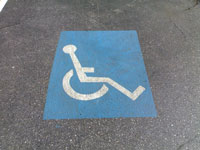 Visual description: A variation of the international symbol of disability access, painted on the ground to indicate a disabled access parking space. The stick figure in the wheelchair is not sitting upright, but leaning back in her chair.
Caption from the original, taken and uploaded by Andrew Anker at Mobile Andrew: This spot is apparently reserved for very relaxed handicapped people.
Harriet McBryde Johnson apparently spoke at some big event in Michigan earlier this fall. As usual, she reportedly had some great things to say about disability rightish stuff. But first, Sharon Emory, the writer of this article has to make clear how twisty and gimpy and short Johnson is:
Watch Harriet McBryde Johnson for a while, and she starts turning your concept of human height on its head.
The "fearless voice for equality and freedom'' -- as she was introduced last month at the 25th anniversary gala for Michigan Protection & Advocacy Service Inc. -- uses a body so molded by neuromuscular disease that it nearly folds over on itself in her motorized wheelchair. "A jumble of bones in a floppy bag of skin,'' is the way she describes it.
The 49-year-old South Carolina lawyer and author wears her brown hair parted down the middle in a braid that hangs over her left shoulder and immediately reaches her lap. Just below are her black-slipper-shod feet, which point downward from the wheelchair footrests, seemingly ready for a pirouette at any moment.
Rising barely higher than the back of her wheelchair, her body exists on a horizontal rather than vertical plane. And that kind of mind-expanding experience is just for starters.
Once she opens her mouth, which she notably has no problem doing, you're likely to get blown back in your chair if you're the sensitive type.
The rest of the article gets down to the business of crip rights -- or rather, human rights, since Johnson challenges her audience (and evidently the reporter) to think in terms of providing for everyone instead of creating special programs for the disabled:
But look back at that part about her opening her mouth:"Why not aspire to a world where all students have a right to a free and accessible education, where everyone can have useful work at a living wage?"
Society has no idea what to do with disability beyond opting to take care of it, hide it, lock it up, let it die "or put it on a pedestal and call it inspiration,'' she says ruefully, all of which involve "setting us apart from the human community.''
Once she opens her mouth, which she notably has no problem doing, you're likely to get blown back in your chair if you're the sensitive type.What exactly does this mean? Why is it notable that she has no problem opening her mouth? Is it a reference to ability or agency? Does it express approval or is it critical? What about Johnson's message will shock the sensitive?
Johnson, who specializes in disability rights law, attained what she calls "weird, semi-celebrity status" when she took on noted philosopher and Princeton University professor Peter Singer in 2001.
Basing his argument on preference-utilitarian principles, Singer made his case for allowing parents to kill severely disabled babies so that, theoretically, as many people as possible could fulfill as many of their preferred choices as possible. Having lived nearly five decades with a congenital disease, Johnson took umbrage at his line of thinking.
It's not mentioned that Johnson's semi-celebrity occured because her richly descriptive and fascinating account of this debate was a cover story for The New York Times Sunday magazine and later a chapter in her book, To Old To Die Young. Nor is Johnson's side of that debate explained, though Singer's specific philosophical approach is described. It's only noted that Johnson "took umbrage" that people like her should be allowed to be killed at birth.
Johnson's message for her speech in Michigan is abbreviated into the article's title "When special isn't good enough." This reads together with the focus on Johnson's body and the failure to show her intellect or lawyerly knowledge as products of an accomplished and perhaps radical mind. It reads as a rebuke for asking for favors -- special demands from those with special bodies. I read this at Disability Studies, Temple U. a few days ago and can't stop thinking about old Junius Wilson.
A 1994 NYT article says this:
Black and deaf, Junius Wilson was 28 years old when he was jailed, charged with assault with intent to rape. He was declared insane and sent to North Carolina's mental hospital for blacks. Then he was castrated.
That was in 1925. Decades later, the charges were dropped, but Mr. Wilson remained in a locked ward.
Now 96, Mr. Wilson was finally moved on Friday into his first real home in 68 years.
"Decades later." The charges were dropped five decades later. Yet the institution kept him locked up for almost two decades more. What caused a reassessment of his case when he was in his 70s?
Sadly, Wilson's problems as a deaf person with the criminal justice system are neither rare nor something that just happened decades ago. I don't have access to the entire article, but an abstract for a paper on "Obstacles Faced by Deaf People in the Criminal Justice System" by Vernon and Miller reports:
Deaf people, especially those who are not well educated, are at risk for serious injustices when they enter the criminal justice system. The present study describes these risks at all stages of the legal process, including arrest, trial, probation, prison, and parole. These dangers are greatest for those who are poorly educated, read at a fourth-grade level or lower, have poor communication skills (American Sign Language and English), and lack awareness of their legal rights. Primitive personality disorder (PPD) is the term mental health professionals use to describe this set of characteristics. The risks that the segment of the deaf population with PPD faces when its members run afoul of the law are described, a case history provided, and some relevant legal and interpreting issues are discussed. A case is made for applying the concept of linguistic incompetence to deaf individuals with PPD.Not that Wilson was necessarily poorly educated -- he may or may not have been -- but he was also a young black man in North Carolina during Jim Crow.
Since the story of Aishah Azmi, the niqab-wearing teaching assistant suspended from her job, broke, former British foreign secretary Jack Straw has been busy making an ass of himself. Or a bigger ass, I suppose, if you're a Muslim member of his constituency. Straw is currently the Leader of the House of Commons and Lord Privy Seal (that last sounds like a bullshit title, doesn't it), and has been handing out opinions about niqab-wearing women.
In this week's The Sunday Times, UK, India Knight writes an opinion about Straw and the niqab called "Muslims are the new Jews." While Knight believes the request that Azmi remove her niqab while actively engaged in teaching English to children is reasonable, the fallout of religious bigotry surrounding the case deeply offends her:
...What we are witnessing is religious bigotry of the most shameful kind. The words used in the context of the veil debate —-- "strange", "“spooky", "“weird", "“offensive", "“creepy", "“wrong", "“evil-looking"”, "“sinister" -- are not words a civilised society should use about other human beings.I'm fascinated both by the way disability keeps coming up as an analogy with this topic, and by the apologies or outrage that seem to follow automatically from that. In the blogging I wrote about in my last post, the outrage was from one commenter (at PunkAssBlog) to another in comparing the choice of wearing the niqab to the lack of choice involved in a severely disabled woman using a wheelchair. In her opinion piece, Knight regrets the need to "equate Islam with disability." The discomfort runs in both directions, and the implication is that there is something unseemly in the comparison.
People are made uncomfortable by all sorts of things: I find shaven-headed, tattooed men unpleasant, especially if they'’re drunk. I'm not mad keen on hooded gangs of youths at three in the morning. Facial piercings hurt my eyes....
But we all need to coexist peaceably. The fact that I find the man in Camden market with bolts through his face, or the Orthodox woman dressed in a drab sack and wearing a bad wig, as "“weird" --— weirder, actually --— than a woman dressed in black with only her eyes showing is neither here nor there.
I don'’t expect they think much of me, either. But I would have to be deranged, or consumed with hatred, to attribute random demerits to them on the basis of their physical appearance. A lot of people are made uncomfortable by disability, for instance -- because they live in a civilised society they don'’t say it.
Imagine if Straw had said, "There are an awful lot of autistic people in my constituency. I tell them to look me right in the eye, otherwise I can'’t help them."” Would there not be an outcry? I'’m sorry to equate Islam with disability, but I am doing so because an observant person'’s religion is as integral a part of them as their genetic make-up.
 There's some fascinating discussion going on at some feminist blogs about the case of Aishah Azmi, a muslim woman in Britain who teaches at a London school while wearing the niqab. School officials have reportedly asked her to remove the face mask while teaching the children because some children have complained of not understanding her clearly. Azmi is a bilingual assistant teacher and many of these children are learning English as a second language.
Feminists seem to be divided on the issue of dress for muslim women generally, with some believing that coverings linked to the muslim faith are always misogynist and others believing that any mandate of women's dress that controls how much of bodies are covered or revealed is the problem, including a country or employer that requires female muslims to not wear a veil. The former claim cultural relativism of the latter and the latter claim insensitivity to the choices of nonwestern or nonwhite women of the former. Well, in a nutshell. There's been much volatile and bitter blogging around the same old issue of white feminists not including the concerns, cultures and realities of women of color in their politics lately as well.
I want to look at this specific case of Aishah Azmi and the discussion on some feminist blogs where disability has come up in more than one context.
At Feministe, where author Jill supports Azmi, commenter Sunrunner says:
I am sorry, but I am going to have to disagree with this. I would not want my child in a class that is taught by a teacher whose face cannot be seen. Think about it–how is a child supposed to feel? Have you ever had an extended conversation with someone wearing a niqab? It is much harder to pick up on social cues . . . is she happy or unhappy with what I am saying? This sort of visual feedback is extremely important to children.Jill responds:
Just out of curiosity, would you oppose your child being taught by someone with a facial deformity?Meanwhile, Gordon K notes:
...Access to facial expression and all of the facial cues that we call “lip reading” is extremely important in learning a language, particularly for students who are deaf, hard of hearing, or apraxic (and many of these students are mainstreamed). So is it appropriate to take a job teaching such a class if you are going to wear a veil?In a reference to the ADA, Sally says:
I’m wondering if it would be useful to apply the “reasonable accomodation” standard that’s used in the U.S. with regards to disabled people. If your religious practice seriously affects your fundamental ability to do your job, that’s a problem. If it merely makes people uncomfortable or requires some extra effort from your employer, then religious freedom trumps.Most commenters in this thread at Feministe believe discrimination of some kind (religion, gender) is at play regardless of their opinion on whether a teacher in Azmi's position should be fully veiled. This includes Leederick, who says:
Wearing a veil hampers her ability to do her job. It makes it particularly difficult for children who are hard of hearing. Her job’s teaching children, and I do think interaction and being able to see someone’s face is very important there.Meanwhile, Sunrunner responds to Jill:
Of course I would not object to my child being taught by a woman with a facial deformity! Anyway, I would assume that if a person is able to speak (necessary for teaching and caring for children) she has the capacity for some kind of facial expression. It is not at all the same thing as a blank, black mask.In fact, this assumption is not correct. While I have some "capacity" for facial expression, many of my facial muscles were the first affected by my neuromuscular disease and the dimple I had in my left cheek hasn't been seen for about 30 years. If you run into it, let me know. But anyone who knows me personally (except those who have known me exclusively in the past year) can tell you that some people with very limited capacity for facial expressions rarely let other people get a word in edgewise. Even just communicating on paper lately, I rarely shut up. Anyway, while facial muscles do effect pronunication and clarity, inability to use most of them has no impact on the amount of speech a person can produce.
So as long as a teacher is only handicapping some of her students’ ability to have a successful life, it’s OK?Language is fascinating throughout this multi-blog discussion. When I find time, I'll post about a muslim woman's ironic use of language and imagery in defense of wearing the niqab in Britain's The Sunday Times.
If a class of 6 - 12 year olds needs to see the teachers lips to understand her ... then I assume she has the training to deal with a special ed class and when she say “the kids can understand me fine” (as she has done) we can pretty much take her word on it - and if she’s teaching deaf kids she should need to be able to sign anyway and that she wears a niqab is an incidental side note that isn’t really relevent.I don't plan to step into the deaf politics minefield that is oralism versus sign language here, but I do want to note that not all deaf children are taught with sign language. On the other hand, R. Mildred does take it for granted that being muslim and deaf aren't mutually exclusive -- or more specifically, being a niqab-wearing woman and being familiar with deafness and sign language -- and I appreciate that.
The niqab doesn’t even hide as much facial information as people assume, it just takes a bit of familiarity to get used to reading the eyes without the landmarks.hell, if a child learns to communicate from a woman wearing a niqab, she’s had a masterclass in reading people’s faces, give them a full face and they’ll be able to read people’s minds.
Lack is described as an asset. Sounds just a little like some disability rights arguments that impairments or inabilities have their own inherent values.
When I studied status in theatre class (by which I mean, the unconcious perceived status that two people feel when relating to each other– not talking about social class here– a king can play low status to a chimney sweep), I learned through experience that anything which makes it harder to read your expression enhances your perceived status in other people’s eyes. So, for instance, sunglasses naturally increase your status because people cannot see your eyes moving; they even may get the sensation that you are calmly staring straight into their eyes at all times, even if you’re really just looking everywhere at once nervously.... Anyway, I imagine a veil would probably act in a similar fashion."Anything?" I disagree with this statement for more than one reason, but from a perspective of my experience as it relates to not just disability but perceived difference (before I was visibly impaired in any other way) I find it to be untrue. Status comes from elsewhere than this.
Gah! I’ve got really serious objections to using that narrative as an anti-veiling argument. Ask anyone in disabilities activism if it’s a good idea to put somebody in a wheelchair “for a day” to show them what it’s really like.Temporary “adoption” of a social, physical, cultural, whatever barrier is NOT the same thing as durable inhabitance of an idenity constructed in response to that fact. The tourist has none of the knowlege, experience, support, training, or coping stratagies, and experiences “disability” in a completely artificial and unrealistic fashion. By selective appropriation or by revulsion, the tourist response almost always lacks grounding or respect.
While the author wrote of her concern of exploring her Muslim idenity in this way, I’m worried that consumption of this article as anti-veil is to miss what this experience is and isn’t. For one thing, it is NOT an accurate representation of what daily life is like for a woman wearing the niqab. Definitionally, a tourist (even one from a nearby country) is not the same as a native.
To that very last, I'll note that it's also not the same as wearing a niqab because you wish to. This slides away from the topic of Azmi and her students, but it is true that the current wisdom among disability activists is that crip-for-a-day programs might do more harm than good. Yet I believe Sunrunner misunderstands Sly Civilian's point because in response there is this:
Oh, so you are comparing veiling to being disabled?
A disability is NOT a choice, a veil is (sometimes). One chooses to wear it for a day or a month or a year or a lifetime, but one does not choose to be disabled. One simply is or is not.
Along with eventually saying she(?) agrees about disability simulations, Sunrunner adds:
Anyway, my point was that it is ludicrous to compare a woman who choose to wear a veil in a country in which it is not mandated with another woman who is confined to a motorized wheelchair due to a life threatening disabling illness. So if my anger is stupid, it is no more stupid than your stupid analogy.Despite what Sunrunner declares, I find the comparison is being made all over the place. Azmi is declared disabled by the veil, her niqab is compared to facial deformity, her ability to communicate is debated with regard to sight, hearing and other physical ability. The ADA and "reasonable accommodation" are invoked. Words like "handicapping" are used. Some commenters address Azmi's abilities, some address the childrens' possible disabilities. Commenters relate their own various disabling learning experiences.These Western feminist debates struggle to balance the religious and cultural freedom of muslim women with freedom from misogynist limits religion and culture make on muslim women's lives. Race is also a factor. And it's clear disability is too, though the thoughts of disabled muslim women (feminists?) are not present here. The niqab-wearing disabled women know these issues intimately and undoubtedly struggles to find balance as well. I know they're out there. But silent in -- or silenced from -- this particular online debate.
As long as disability has been introduced here, any deaf children in the classroom would be required to ask her to remove her veil if they wanted to understand her, or be removed to another classroom if she refused. And before any of you pile on me, *I* was that non signing deaf child in the class who constantly had to teach her teachers not to face the blackboard, to look at us, etc. To this day I still have to educate my teachers (I continue taking classes in all kinds of things.) Access to the visual expression on someone’s face is critically important for me and other non signing deaf. It is not a choice. It is not “some whitey” making glib objections. It’s a fight against ableism or disablism (pick your country).I don't know if "anonymous" was truly heard. Neither R. Mildred or Jill, the original posters at PunkAss and Feministe, respectively, have appeared to consider the intersection of disability, though it's part of the discussion everywhere.
My friend Amanda at Life in a Suitcase tagged me for this feminist meme that is traveling around. It started because of concerns (and outrage) about funding changes by the Canadian government for Status of Women Canada (SWC), including the removal of the word "equality" from the government agency's mandate. I don't know the intricate details of all this, but the meme is certainly a good topic to think and write about.
My five things:
It provided me with a home to grow up in where my parents respected each other and nurtured everyone's dreams and goals regardless of gender.
It made my study and career choices at college free from the gender restrictions and pressures my mother experienced.
It's given me a context in which to understand my experiences with religion and my spirituality.
It's added to my interest and understanding of my experiences as a disabled woman.
It's provided me with many many warm, loving women friends, both out in the world and online. Stunningly, during my four-month hospital stay, I received snail mail and packages (as well as online prayers and support) from dozens of individual feminists all over the world -- all online friends or acquaintances that at the time I'd never met. I've since met eight of them in person. Our common concerns and experiences brought us together online and provided me with support when I needed it most. (Amanda is one of them, btw.)
The second Disability Blog Carnival will be here Thursday, October 26. Submissions are due Monday, October 23. The theme for this stop on the carnival tour is "The Cure," though any submissions about disability rights, disability culture, or personal disability experiences are welcome.
By "The Cure" I don't mean (as Penny noted) that I'm looking for posts about the fine but gloomy alternative band of the '80s. I'm refering to the issue -- or question -- that pretty much defines how people think of disability. Dan Wilkins wrote this about "the cure" while a board member of the National Spinal Cord Injury Association:
Society needs to understand that, of the nearly sixty-million belonging to this U.S. Disability Culture alone and millions more around the globe, those who dream of cures are far and away in the minority compared to those who dream of acceptance and access to all that their society and community has to offer. The majority of us with disabilities are comfortable in our skin. We see ourselves as unbroken and not in need of "fixing". We are proud of our disabilities and of the wisdom and perspective gained from the experience. The majority of us, along with our friends and family, dream of the equity and respect that comes from a community that has expanded to include and accommodate all of its people.
It is a matter of two different dreams. One dream sees the person; or more precisely, the disability as the problem. The other, more widely held dream sees society itself and the environment as the problem; with its lack of attitudinal, architectural, political and programmatic access. The former sounds logical, based upon archaic misconceptions of what life “must be like” for those living with a disability: "Of course one would want to be healed." The latter demands we, as a community, step back and take a look at the bigger picture, at how we perceive and treat people who get around or see or hear differently. It demands we take responsibility for our thoughts and actions, the baggage we carry, and for the history of exclusion and segregation. It is discrimination and it must end.
Back in 1996, David Mitchell said this at Electric Edge:
The key tension that exists in nearly all stories about disability is seen most clearly in the "cure narrative." It's a story of uneasy obliteration, for it always ends in the "loss" of the object upon which it depends: Either the disability is eradicated and surrenders its seductive interest, or it resists conforming to the narrative of its rehabilitation and the evidence of that refusal must itself be obliterated. This is what Paul Longmore means by the "cure or kill" paradigm: both get rid of disability.Mitchell refers to "stories about disabilities," which certainly applies to literature and film but also to the stories of our individual lives and the narratives people imagine about every disabled person they see. "The cure" is the persistent human project to fix people of impairments rather than accept their lives as good enough, valuable as they are.
My computer is off to the shop for a hopefully brief period of time, so I may be offline for just a day or through the weekend.
In the meantime, go to Disability Studies, Temple U. where Penny Richards has the first ever Disability Blog Carnival with an amazing collection of offerings to read from an incredible variety of sources.
See you soon.
A recent sitemeter check reveals a Google search for "What Paul Reeve said at the end of his famous ride?"
Possible answer: Spell my name right.
 Visual description: In the foreground a sign reads "wheelchair access" with an arrow pointing to the background, which looks like lumpy prairie or grassy beach. Absolutely not wheelchair accessible. Nothing manmade appears beyond the sign.
Originally uploaded at Flickr by inframel
I met Marian the day I came to college in my week-old electric scooter, still learning how to drive it well. She was my assigned roommate in the residence hall and we were the first two female disabled students to ever room together at our university. With only a few accessible rooms, my freshman year was the first that there were enough women in wheelchairs to require two to a room to fit everyone in.
Campus housing had called me over the summer and asked if I was okay rooming with another disabled woman, apparently concerned if we'd have enough room to maneuver. I'd thought it was a stupid question -- if I wasn't okay with it, would they quick remodel another room before I arrived in two weeks? Also, the slim detail that my new roommate would also be using a wheelchair excited and startled me. I hadn't considered it before.
Marian and I were happy roommates and became close friends immediately. Our resident assistant turned out to be Anne, a disabled woman Marian had been tight with as a child at Easter Seals summer camp. Marian, pessimistic and wryly funny, and Anne, loudly hilarious and over-the-top, were a completely new experience for me. I hadn't had friends with disabilities -- let alone scooters or wheelchairs -- ever before. I revelled in the startling visual power we had when we went somewhere, lining up serially on a narrow sidewalk like a brief parade of fast go-cart Shriners or driving three (sometimes more) abreast across campus and talking and laughing like anyone else, but at our seated height.
Sophomore year, by arrangement, Marian and I shared a bathroom with Anne, and we often treated our two dorm rooms like a suite by keeping the bathroom doors open so the bathroom itself became a narrow hallway from one room to the other. While the bathroom -- just a toilet and an open area with grab bars for a shower and room for a shower chair -- was all tiled and slightly sloped to a central floor drain, there was an eight-inch ramp sloping an inch or two down outside either doorway (Anne's or ours) into the small sink/foyer area of each dorm room. The closets faced each bathroom door, so if you stood in our closet, you could look through the bathroom into Anne's closet, directly opposite.
Early one evening just after dinner, Marian and I were in our room. Marian was sitting in our small closet finding something and I was talking with her, my scooter parked in front of the closet doorway.
Anne came roaring through the bathroom into our room, laughing as she came down the little ramp. To our surprise, her Amigo scooter hit the side of my scooter and her front bumper lifted to rest on the platform of my scooter by my feet. The front wheel of her front-wheel drive was lifted off the floor.
So. Marian was trapped in the closet. I was parked in front of the closed door to the hallway, and Anne's scooter was hung up on mine. We all used our chairs full-time, so none of us was able to get out and push. We sat there surprised that three mobile adults could immobilize themselves without any of our chairs breaking down.
This was before cell phones, so we giggled when the phone rang and our answering machine clicked on. We contemplated what exactly we would shout if we decided to holler for help. Then we jokingly began conversations none of us wanted to hear and required a captive audience.
"Have you been saved by the Lord?"
"Let me tell you about my essay on Moby Dick."
"You know, my husband had a stroke recently and now he needs a wheelchair too...."
We nearly laughed ourselves sick before I managed to move my scooter back and forth enough to dislodge Anne's. It was a bit of a disappointment to be free. Suddenly the room was accessible to all of us again and we were a little less bound in common camaraderie.
It was one of the silliest, funniest moments of my life, though it doesn't translate well for the larger world. It's a crip thing, and probably rare at that. It's an example of what makes living with a particular disability a unique cultural experience. One I would never have found at home with my family.
Embarrassment is the least of 18-year-old Rozina Rehman's problems after her back was broken a year ago in the earthquake that killed 75,000 people and scarred the minds and bodies of many, many more.
The first anniversary of the quake is on Sunday, but the young woman remains too self-conscious to go back to school in a wheelchair, so she stays home with her parents.
"I am scared what people will say. I can't get out of this wheelchair now for life," says Rozina, who was dug out from the rubble of her home in Balakot, in Pakistan's North West Frontier Province, one of the towns hit hardest by the disaster.


